Friday 04 September
A few years ago, when I was cutting back the overgrown hedges in our back garden, I came across a row of hawthorn trees.
They made up the skeletal frame for the climbing ivy and rambling honeysuckle that veined confidently around and through them. Bridging the gaps between them and stifling what were the original hedgerow shrubs.
Every spring I had noticed blackbirds, tits, robin and wren being consumed by this safe and secure mass of green. The kindly accomodating hawthorn was providing shelter and support to both plants and birds. I dare say there were quite a few invertebrates and ground based creatures that also took refuge amongst its branches and beneath it’s canopy.
So, I cleared away all of the ivy and honeysuckle to reveal half a dozen scrawny and spindly specimens. But they had sound roots and so I cut them back and waited to see if they would recover. They did and I soon appreciated how important these hawthorn were for to garden birds. One tree in particular, the tallest, is also the noisiest in spring and summer as it plays host to flutters of sparrows, ten or twelve strong. The long-tailed tits are now joining in too making a beautiful racket.
Anyway, on the radio this afternoon, I was pleased to hear that the programme’s tree of the week was the humble hawthorn. The particular featured tree, located on the Bristol Downs, had become a community focal point during and ever since lockdown. Local folk had used it to hang or drape their wishes in the form of pompoms, ribbons and other memorabilia. But amongst all of these colourful trinkets there was a faded black and white photograph and a poem, hung alongside each other, from one of the branches.
The poem is entitled ‘Seabird’ and the photo is of young woman in 1940’s army uniform called Daphne. These tributes to Daphne, who died in a care home this spring, were hung up by her sister and children. The poem, written by Daphne, was a tribute to her husband, Ernie, who had died twenty years before her. She writes of his free spirit flying high.
You see, sailors commonly believe that when they die their spirits takes the form of a seabird. Ernie was a sailor, and she writes about how one day she hopes to join him up there. Two souls together again.
“Oh Seabird, riding high above the foaming crests. Then wide wings spanned in abandoned flight. To north, south, east and west. Far and free. If only I could fly with thee.”
“Below there are flowers and prayer, they wrap me in a linen shroud. But I have not a care, for I wing on the wind, and climb on the cloud. My spirit soars free. Now Seabird, I fly with thee.”
The spiritual force of trees and birds wrapped up in a beautiful story of companionship and love.
Whenever I stand for a while and watch birds flying high, I am filled with a kind envy. How I wish I could do that. Well, one day, maybe I will.
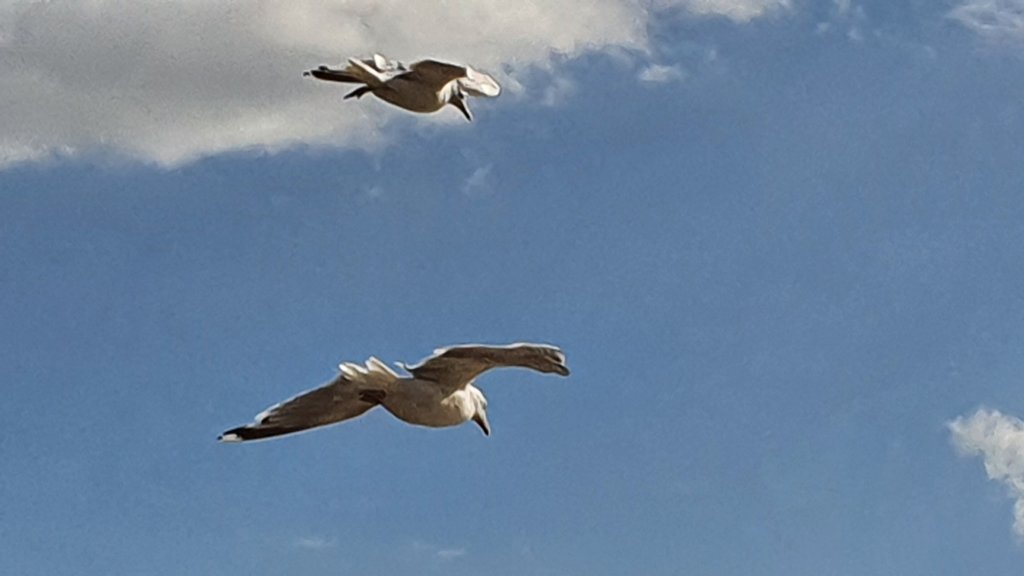
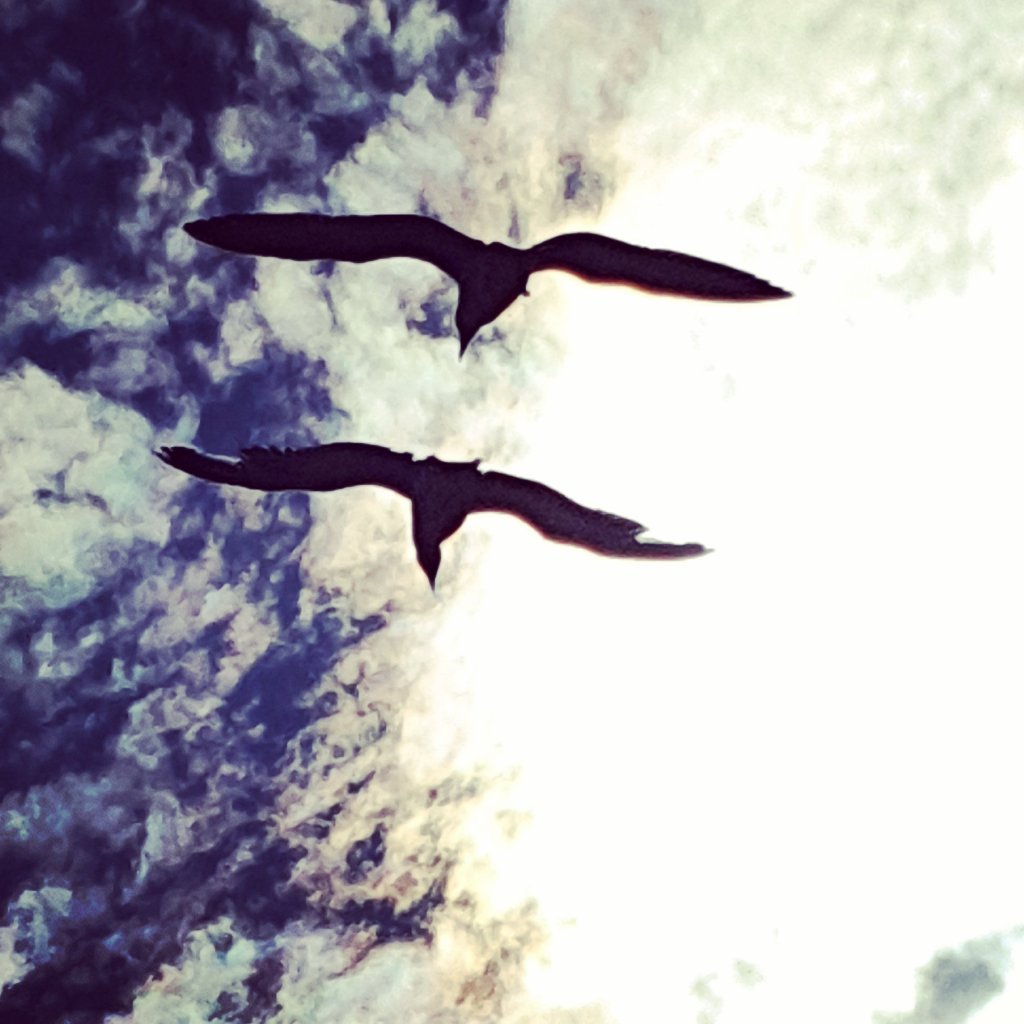
Seabirds are certainly the best at that, seemingly flying for the fun of it. Simply because they can. Playing, practising or perhaps, waiting for their partner to join them at some point. Next time I see a pair together, I will cast a thought to Ernie and Daphne and others who’s spirits may now be soaring free.
(The final five minutes of this episode of PM https://www.bbc.co.uk/sounds/play/m000m5zv)
 The Bald Birder