Ten days ago I visited Mum in the care home. It feels less than that, which is good. I will see her again next week hopefully, or the week after that. We are having to limit our visits to one person and one visit a week at the moment, whilst they try to minimise the risk of infection from the outside. Obviously, if COVID19 hets into a residence of the elderly and frail it can be devastating.
I was reflecting today on things we like and dislike. I refuse to say ‘hate’ as I feel that word is over used and is too strong for such things. So, for example, we went to Lakeside shopping mall. I really dislike malls.
Firstly, at a base level, I cannot stand the name. ‘Mall’. Its one of those words that has multiple pronunciations. Make the ‘a’ short or long, even make it sound like ‘morl’? But getting over that, they are massive hubs where people go to consume unnecessarily. Clothes they don’t really want, stuff they don’t need, food they could do without.
They’re a trap. I got partially snared myself today. I’ve heard them compared to an ant colony with thousands of little workers scurrying here and there. But, ants are doing important stuff in their nest, each one has a responsibility. It was interesting to see quite a few people there, but not many were carrying bags. People are looking, but not buying. A crude sign, perhaps, that the economy is struggling to recover?
Sadly not a picture of my game but this is where I officiated the U16s tonight, Wivenhoe Town FC. Great fun.
Then we got home and I went and refereed a football match. Another pre-season friendly. It was great. Fresh air, rain, wind, and the smell of a grass pitch that has just been gained on. And floodlights! My first under lights. I like refereeing football matches alot. I also liked driving up our bumpy lane when we got back.
I used to make occasional journeys into London and I always noticed the smell when I got off the train after travelling home. A day of man-made smells numbs your senses, then you step off the train and take that first deep breath of fresh air. Pause. And the senses are awakened again. I like that.
This past year I feel I have grown up and understand fully what I like and what I dislike. It sounds almost to simple to make a pointbof, let alone a blog post. But it is really important for me to know these things and make a mental note of them. It helps, amongst other things, to help me know what to avoid and what to seek more of. The walking, the outdoors, the natural world around me, the ones I love; I like those things and I want more of these in my life than yhe things I dislike. Sounds obvious.
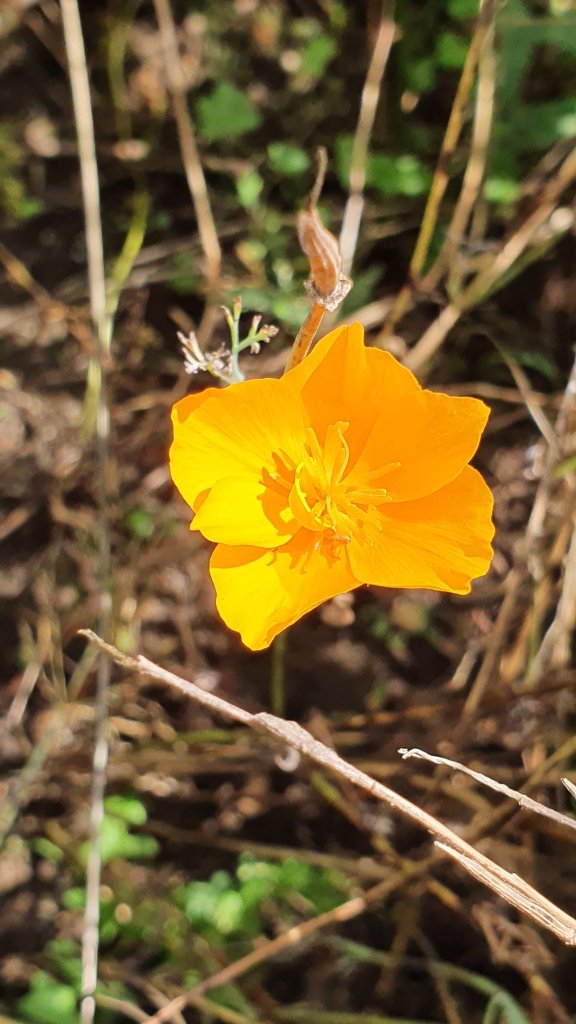
I found this wildflower growing in the grass where we walked the dog earlier in the week. I didn’t know what it was so emailed a bloke who has a website all about UK wildflowers. He emailed back the following morning to tell me it’s probably a Californian Poppy (Eschscholzia California). Thank you, Richard Darlington.
Finally, the strong winds of storm Fancis have subsided this afternoon and things are returning to normal. That’s a nice turn of phrase, ‘returning to normal’, let’s hope we can say that with more certainty and frequency over the months ahead.
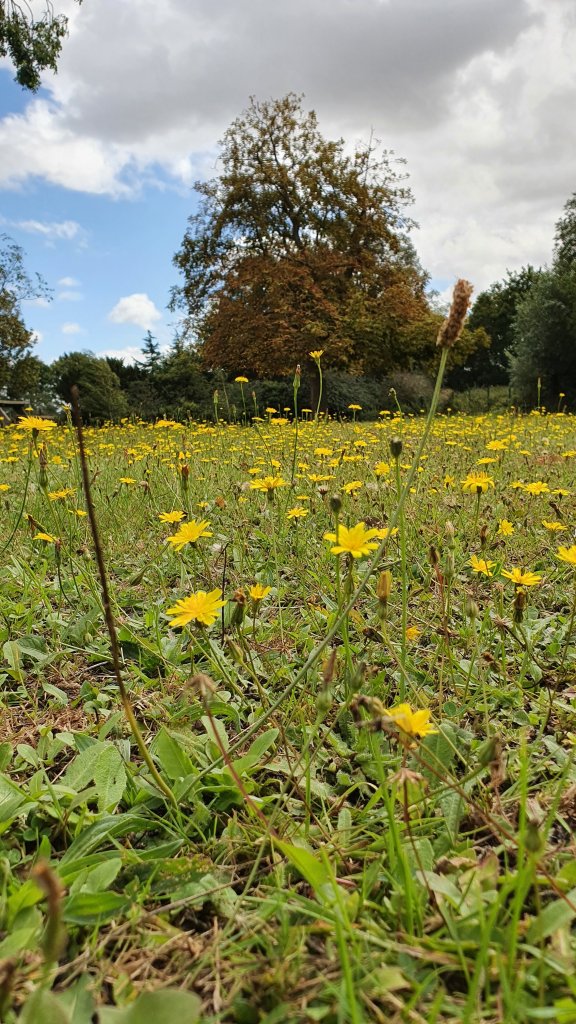
Mouse-eared Hawkweed (Pilosella officinarum) has burst into bloom in the field out back at work this week.
I have neglected to mention the view from my back garden of late. I feel I need to check in with this more often. During lockdown it became my daily window of wonderful things. As spring became summer, the content of this view altered, sometime subtly and sometimes more abruptly.
The grass is scattered with debris form the trees; a few twigs and branches but no leaves which is a good sign. When Autumn comes creeping, there is always an angry, windy day that strips the clothes from the limbs of the trees. That’s always my own red-letter day that summer has ended, even if autumn hasn’t quite begun.
Back to today and the ‘returning to normal’ theme. Now that the wind has calmed down the birds are back out and today, I finally got to see the Sparrowhawk again. It’s been around for the whole of the summer but has always eluded me. I say ‘the sparrowhawk’, singular, but I think I saw a fairly young bird. So there may have been a family around.
Looking through my window of wonderful things, I saw it in the orchard making steady runs along the line of trees forming the windbreak. It would climb into the breeze and hold a position, just higher than the tallest trees, looking down on the sparrows and finches flitting amongst the apple trees below.
It didn’t dive at all, making me think that it was young and possibly a bit of a hawking novice. It then became clear that an altercation was in full flow between our sparrowhawk and a crow. A few weeks back, I had seen a rather ragged looking crow giving a heron a hard time over the field next to our neighbours pond. And again, a few weeks before that to a lone buzzard that had split from it’s trio. I think it is likely to be the same one, I hope so anyway.
I love the idea of a cantankerous old crow giving these young upstarts a bit of grief. He (I’m saying that he’s a male) is like an old man, stick-shaking at the trespassers. If I kicked a football over there, he would confiscate it and probably burst it too. The young sparrowhawk is just learning or playing, doing what they do, but the old-crow hates to see youngsters enjoying themselves. Back in his day…grrr!
Anyway, the sparrowhawk gave as good as he/she got and after a few minutes was repeating his training flights along the edge of the woods. And the old-crow with his missing feathers? Well I imagine he hobbled home with his grumpy disposition and mumbling how ‘Kids today. When I was their age….hrmph’
Storm Francis has landed in the UK bringing lots of rain and very strong winds. I was hoping to take in a coastal walk this afternoon, but after an extended spell at work this morning, and the unfriendly weather, I decided not to.
The wind whips clouds into ever-changing formations. All of a sudden it is milky grey across the whole sky, then quickly as you like, the sun breaks through and blue sky appears. But not for long.
These unseasonably strong winds are really testing the integrity of the trees around us. Their branches are obviously still full with leaves and fruits so they become sails catching each gusts full power. The strength of each branch and root system is being seriously tested.
The seeds from many of them are being whipped up and about. Many are making their way through our windows and into the house. The birch and budlea seeds in particular are sitting in mini clusters on our window sills and being caught in cobwebs.
Everything with a pulse goes into hiding during unfriendly weather such as this. I often wonder where it all goes? Obviously, thick hedgerows become perfect shelter for birds and ground-based creatures just burrow that little bit further down. Deer and other mammals will find suitable nooks and crannies in wooded areas.
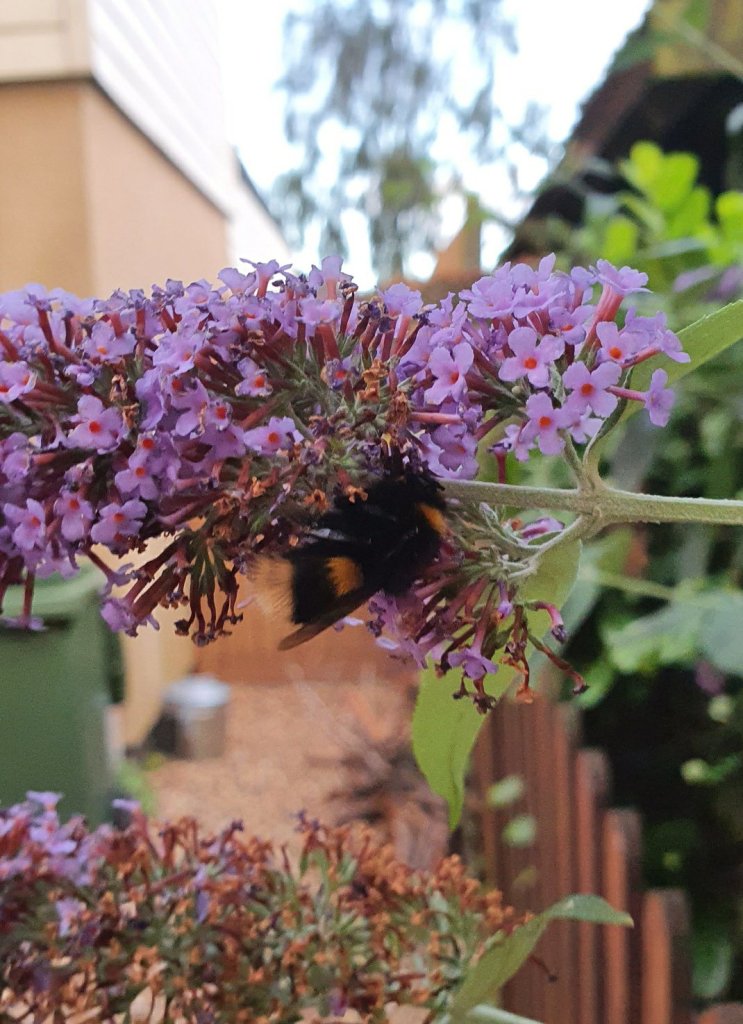
A buff-tailed bumble bee takes shelter on the northern side of a budlea flower cluster. The strong southerly wind is pushing it about, up and down, left and right, but it clings on admirably. I reckon it will still be there in the morning.
But what about the trees themselves? Once again they stoically come to our rescue, unwaving in their charity. So many living things benefit from their generosity. On our dog walk this evening we passed many trees, some old some not so old. But all were providing shelter. To funghi and plants on the leeward side, for example, and to so many invertebrates within it’s bark, branches and roots.
I occasionally like to play a silly little game of personifying flora and fauna I come across. For example, what sort of personality would that robin have? What human traits might that butterfly have? What sort of job might they do? Would we get on? When I see a big old tree wrapping it’s solid, gnarled arms around so many other living things, I can’t help but think of the ghost of Christmas present from A Christmas Carol.
Ok, look, I know it’s still only August and to make a reference to Christmas is a bit odd. But as a bloke on the radio said the other day, August is virtually September, and September is pretty much winter which is when Christmas is. So, I’m going to roll with this analogy.
The ghost of Christmas present was originally depicted as a big-hearted, ‘jolly giant’ of a man, in a full length, green cloak and brown boots. He would talk of his many brothers that came before him. He carries a cornucopia providing fruits, nuts and berries for all to eat. He has the ability to appear in different shapes and sizes. And most importantly, he would great Scrooge with the immortal line, “come in and know me better, man”. A rallying call of peace and goodwill. In rain, wind and blistering sun trees bring peace in the form of safety and shelter.
Now what is that a description of, if it’s not a big, old oak, sycamore, ash or horse chestnut. They get blown about, but their good-nature does not stop giving. I like to think Dickens would agree.
I normally compile my posts at various points throughout the day. Something happens or pops in my head and I make a note of it. But today, I have come to a completely blank space just minutes before midnight. I feel a bit pressured, that I’ve let myself down somehow. A very odd feeling. But today has been a day where my thoughts have been very much focussed on returning to work next week. I am reviewing our risk assessment in readiness for reopeing the school fully, to all pupils and to all staff. With minimal clear instruction from the government, I feel confident that we, at least, are applying the scientific advice to what the DfE has published and filling in any gaps with a good dollop of common sense. We will see.
Earlier today, my brother sent me a message to say that there was a programme on BBC Radio 3 this evening that I may be interested in. I love the radio, and for a while, thought it was a generational thing that would die out with the distractions of Youtube and social media. But, it would seem that listening to the spoken word has never been more popular. Podcasts have done much to promote this resurgence as has talking books via platforms like Audible. The new BBC Sounds app is excellent.
It’ll make you happy, it’ll make you sad. But it is beautiful listening to the birdsong from this crazy Spring 2020.
For me, lockdown and the impact of this past couple of years has changed my listening habits. I find listening to BBC Five Live now very boring and uninspiring. I used to listen to it all of the time, especially the football, but also the news and opinion. That would be my late night ritual before bed when the house was asleep and quiet.
But my brain no longer wants to hear this sensationalist, ‘fast-food’ audio. A friend of mine once referred to Five Live as ‘tabloid radio’ – he was spot on. Now it’s Radio 4, Classic FM and Radio X (my son introduced me to the last one). Ok, so I have to cope with the adverts but that’s ok, for the moment. I guess I am conscious that I don’t want to waste my time listening to sports people gibbering, and politicians patronising the listener and lying. I still love sport, politics and current affairs – and I guess that’s why I want a different experience.
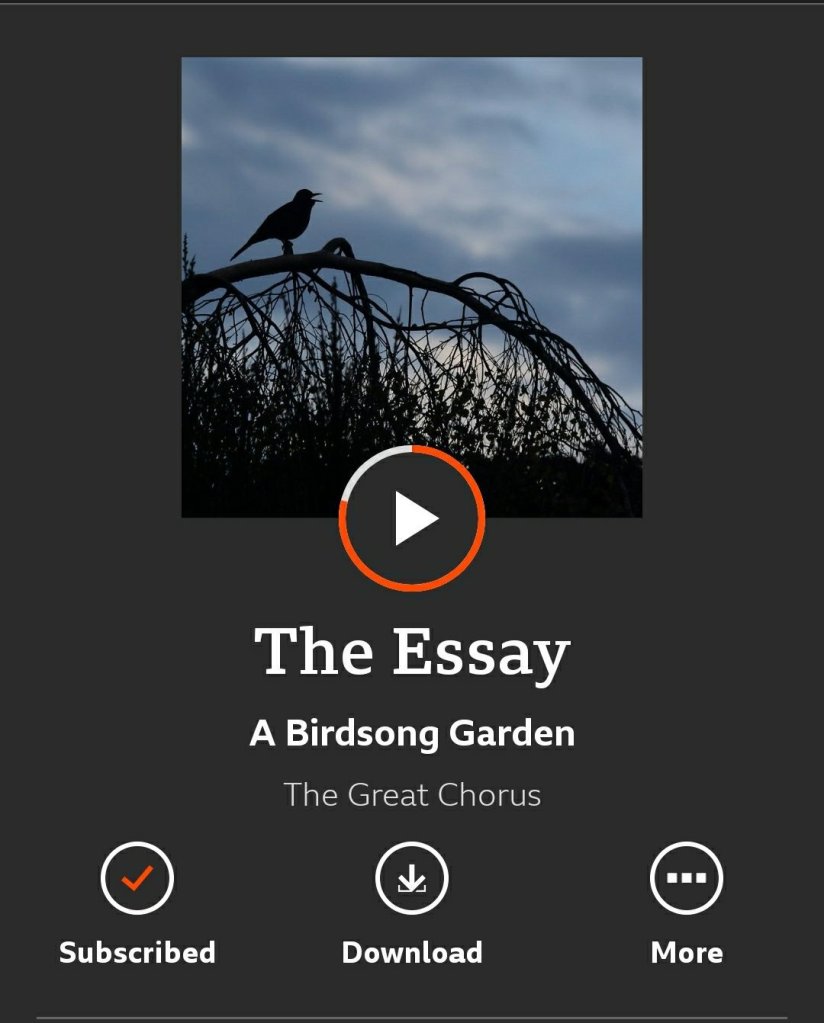
So, back to this programme recommended by my brother. The Essay, this evening on Radio 3. What a remarkable programme. The presenter, a sound recordist for the BBC’s nature team is sharing his recordings of birdsong throughout the weeks and months of lockdown, and has added a wonderful lilting north-eastern dialogue to them. This first episode of five has focussed on the sound of the May dawn chorus from his back garden in Northumberland.
It made me happy on the most part but quite melancholic afterwards. The sounds of the full ensemble of feathered songsters got to their perches and let rip. Why sad? Well, because I really miss the month of May and the sound of the birds. I really miss it. It has made my insides fall with a slight jolt; like when a teenage relationship ends or great book I’m reading reaches the final chapter. And this year in particular, I have personally heard the best birdsong-filled mornings and evenings ever.
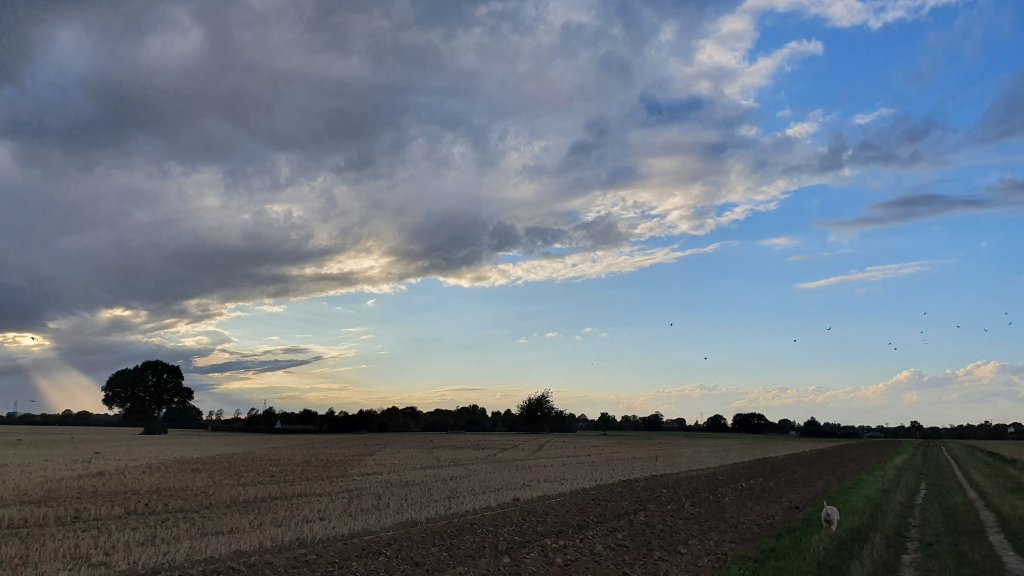
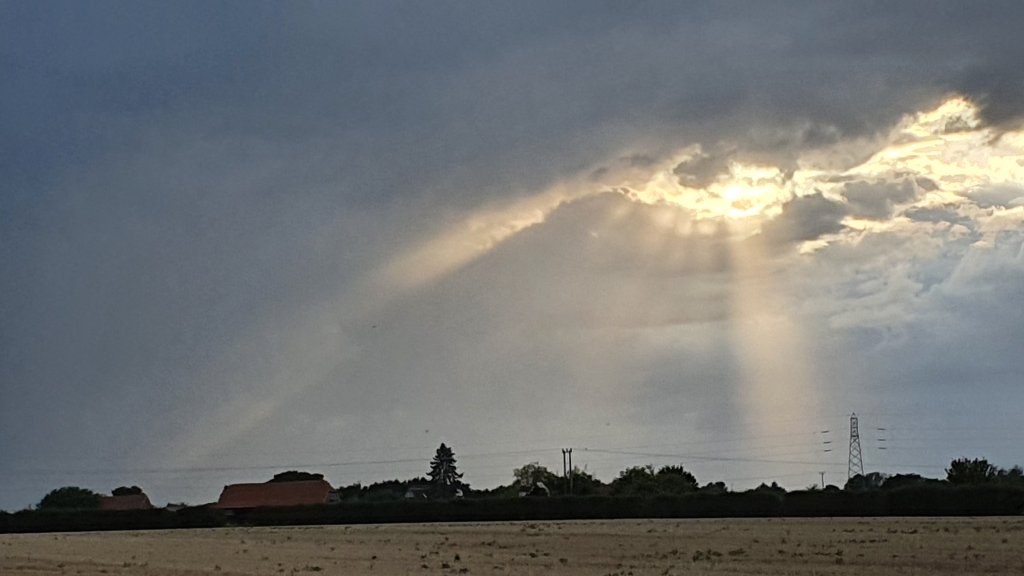
The sky on our dog walk this evening. Just me, Lisa and Mabel. We are so lucky.
The evenings are beginning to draw in a little now, and the weather is taking a turn for the worse. The start of autumn is now nearer than the first-day of summer. Spring feels a long time back and the sound of the birds on the radio is starting to retreat as a tinny echo as it drifts off into the past.
But, I must always remember that by the time we put the clocks back, the start of the next spring will be nearer than the start of the last. I am going to make next spring a season of birdsong to remember – I have risen early enough to get to some woodland and listen to the first soloist kick things off. I will next spring.
So, thank-you, Bro, for sharing that programme with me. I am going listen to them all (multiple times I am sure) and remember how inspiring a time lockdown was for some of us. The simplicity of our beloved birdsong, that we do tend to take for granted, is what inspired this blog. To appreciate what is right there, in front of us, on our doorstep, if we would only take time to listen.
When Autumn blows in and Winter snaps around me, I will listen out for our Robins, Blackbirds and Fieldfares. I pledge to stop, take a deep breath, and properly listen. I pledge to never take their beautiful, simply-complex sounds for granted again.
What a treat I have had today! For Christmas, the kids bought me a raptor experience day for two. An early start for me and my mate Pete as we finally got to do it this morning down in south Essex.
The first bird out and one of my all-time favourites. The Barn Owl (Tyto alba) is just an iconic bird of the British countryside. I have sadly never seen one in the wild (yet) but to have this beautiful female fly from it’s perch to my gloved hand was worth the journey in itself.
We got close to about half a dozen birds, some we got to see, others flew to us from a perch. First was a female Barn Owl, she was everything I anticipated. Graceful, quiet, serene (for a hunter). I am yet to see one in the wild but will do in time. It was so light and is mostly feather. This one had been found as a chick with a head injury. It would have perished if left. But here it was, flying, feeding and perching on my gloved hand.
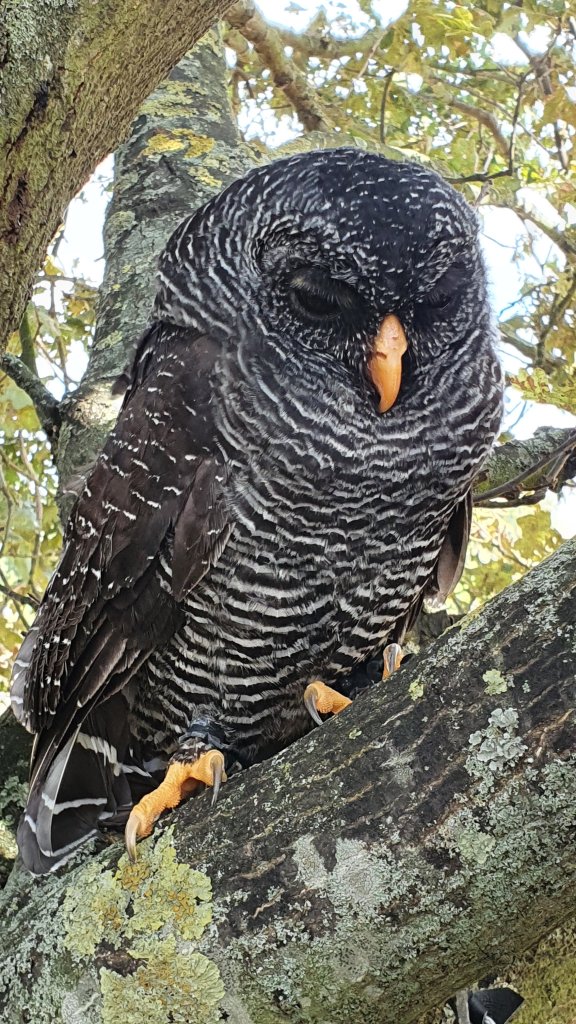
Most of the birds were not indigenous to the UK or even to Europe. This Black-and-White Owl (Strix nigrolineata) is native to the rainforests and mangroves of South America.
Many of these birds have usually ended up in the care of this, and other bird of prey centres, because they were injured, abandoned from captivity or because they became unwanted pets. Pets!? How can anyone think that keeping one of these wild creatures as a pet is a sensible thing to do?
To be able to see this male Kestrel (tinnunculus tinnunculus) so closely was a real treat. I have only ever seen them from underneath as they hover over fields and roadside verges. We have four resident falcons in the UK; Kestrel, Hobby, Merlin and Peregrine.
I have to admit that I did feel a little mixed about being there though. Our expert guide clearly has a love of the birds and a passion for the subject. They spend a lot of time in schools educating young people about the birds and the need for us all to protect their habitats and the environment generally. It must cost a lot of money to do so; I guess these experience days help fund their educational work. But, despite being mesmerised and in awe of simply being with these fantastic creatures, I occasionally felt awkward about their captivity though. They are exercised daily and treated very well, but they are transported in the back of a transit van, albeit very professionally and safely. And they are not free to fly and hunt as they are designed to.
I had to take a picture of the talons of this Eagle Owl (Bubo bubo). Owls have four toes, three front and one rear, but when perched the unique flexible joint of the inner-front toe enables it to turn to the rear to aid stability. These talons are tools of destruction, designed to inflict maximum damage to it’s prey, tearing limbs off or removing the head of whatever it has caught.
When I was a little boy we had a budgie. It lived in a cage. It was beautiful and I remember gazing between the bars at it’s features. The nobbly bit above it’s beak (cere) where it’s nostrils were located, it’s scrawny feet and claws and it’s brightly coloured plumage. I watched it’s mannerisms, how it would scuttle along it’s perch from end to end and how it’s head would bob up and down. Way back then, I don’t recall giving it any thought whether it would be happier outside of the cage. However, I do know that being able to study our pet bird at such close quarters started my love of birds. But we thought it was a little bonkers, it’s behaviour became eccentric and odd. I can only imagine that was because it was kept, on it’s own, in a cage.
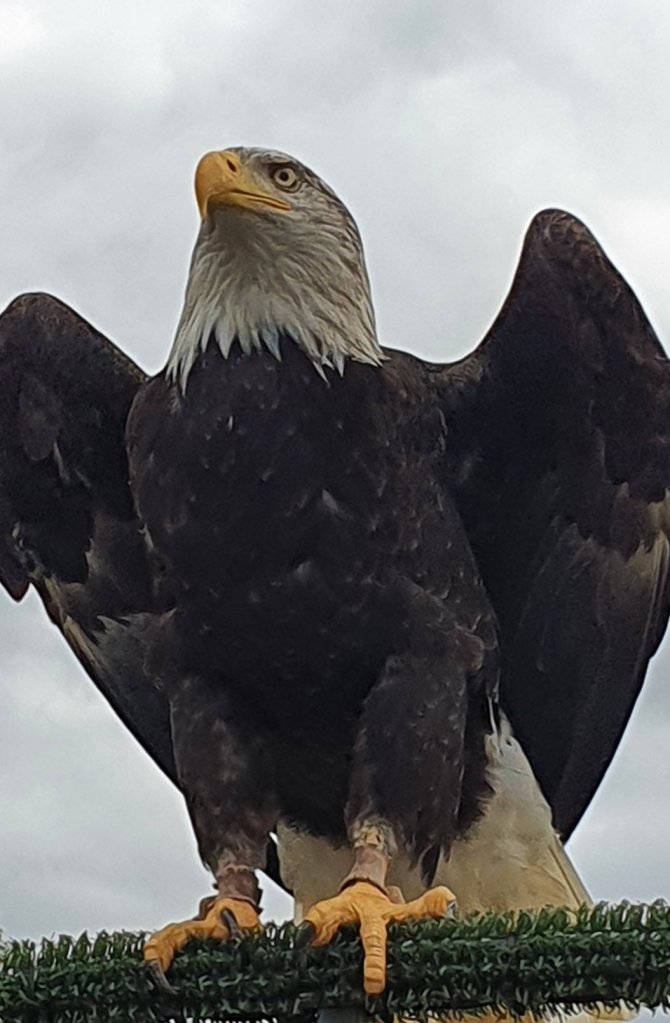
The Bald Eagle (Haliaeetus leucocephalus) is closely related to the White-Tailed Sea Eagle. It’s obviously not bald but has a white head. It is native to north America and has a huge wingspan of around two metres.
So, this amazing collection of birds, that are ferried around for folk to ‘experience’ (especially young people) has to be a good thing? In the past these birds may have been destroyed, whereas today they educate us. The focussed message must always be to protect them and their natural habitats in the wild. Any birds that end up rescued and captive must be able to educate and inspire not simply entertain.
Oh, and don’t raptors have the coolest Latin names?
A casual morning at home was followed by a sprint to the beach for late afternoon. Back to the birds again this weekend.
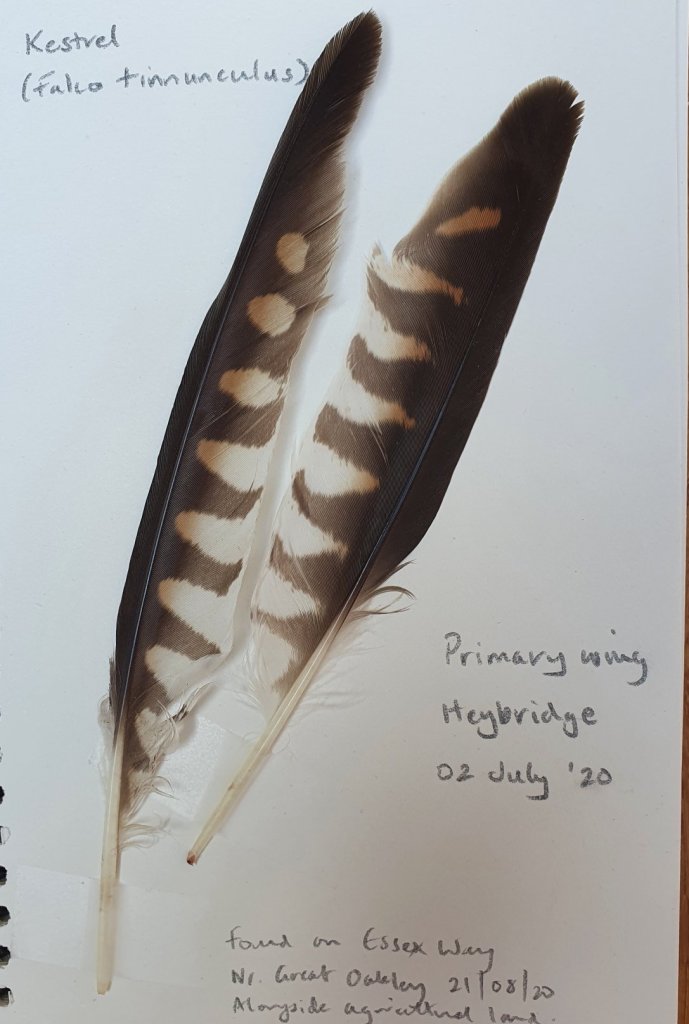
A second sparkling kestrel feather. It’s great to be able to walk along and recognise feathers without needing to pick them up.
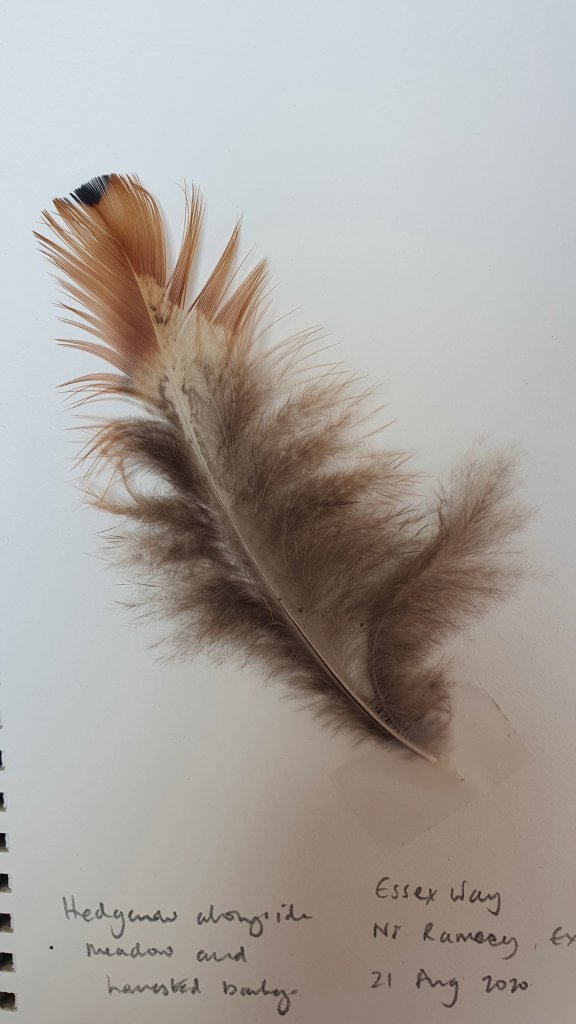
Before we left I spent a bit of time adding a couple of feathers to my book. They were collected yesterday on my walk. Another from the wing of a kestrel and a mysterious feather that I cannot identify. I am hoping it’s an owl feather but will hopefully find out one way or another tomorrow. A friend and I are heading to south Essex for a bird of prey experience day that the kids got me for Christmas.
A mystery feather. I am hoping it’s an owl as it’s so fluffy. The feathers of an owl are like this to aid silent flight. But…?
It’s far too windy and cool for a swim. The angry tide was in and smashing waves against the groyne and promenade. Not a day for swimming.
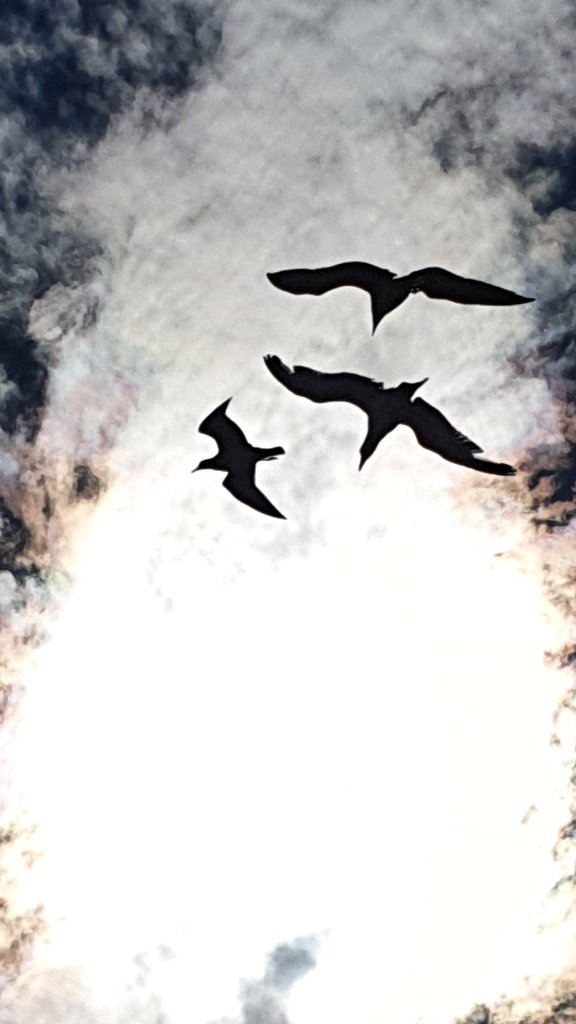
But the gulls were floating, head-first into the wind watching the brave souls crabbing below them. Everytime some bait was lowered into the water below the sea wall, the gulls were swooping down to try and snatch it.
Chuffed with this pic. Overexposure is easily handled on a phone. The gulls at the beach this afternoon just hung in the air, eyes down, waiting to clear up what we drop.
Again, another bird (or family of birds Laridae) so taken for granted by us. In fact, in recent years, they have become vilified by many for “terrorising” holidaymakers and those who choose to eat their food outdoors; where seagulls live. Take the sound of the seagull away from the seaside, and you lose the seaside.
For some reason we love to blame nature when nature adapts and fights back. It is us that have moved in on their patch! They were patrolling the coast for food way before we built fish and chip shops or burger joints. We have made it easier for them to get food, simply because we chuck so much of ours away. Basically, our greed has led to their need. They have successfully adapted to life alongside our wasteful, polluting behaviour. If anything, we should be applauding not only their ingenuity but also that they clean up for us after we have finished pigging out.
After yesterday’s post, diverting slightly away from the kinds of things I normally write about, I am going for a walk in the great outdoors. I need it. In previous summers, I have cycled with the kids, from Harwich to Home. But I want to walk it this summer. I’ll do it in two parts.
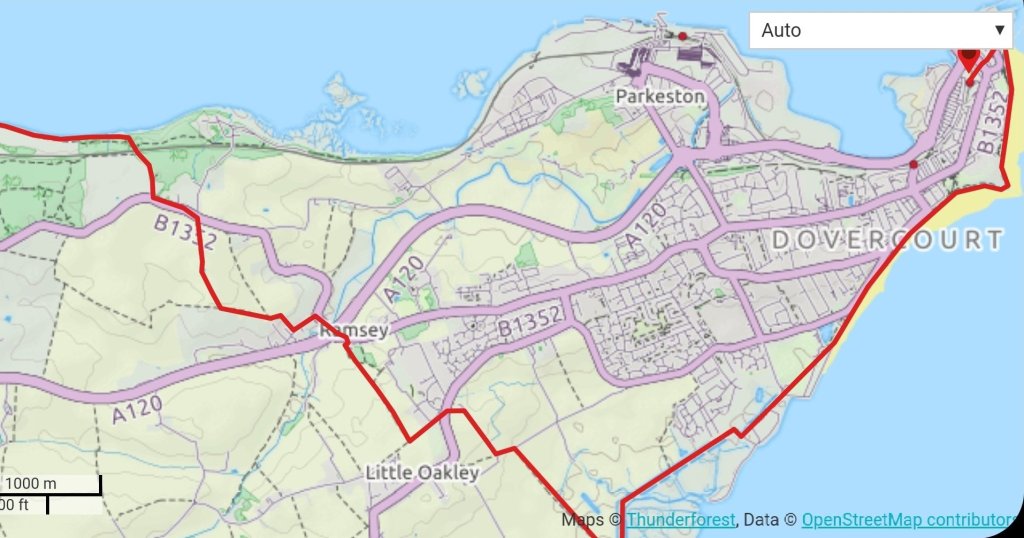
8.1 miles, Harwich to Wrabness via Dovercourt and Ramsey.
I am walking from Harwich to Wrabness today. An eight-mile stretch of the Essex Way which spans the county from Epping in the south to Harwich in the north-east. I set myself a challenge this summer to walk from Harwich to Manningtree, so have split it into two eight-mile(ish) chunks.
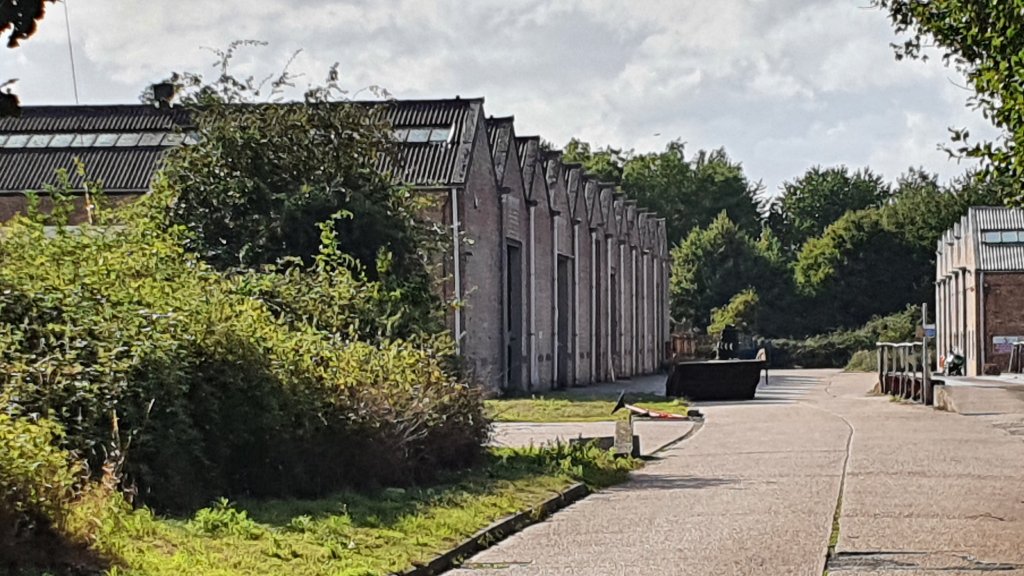
11am waiting at Wrabness for the train to Harwich Town. It’s a very windy day, seeds and fluff and other flotsam is swirling around the platform. Wrabness station nestles in a gully.The storage depot at Wrabness used to house sea mines for the MoD. It’s now in civilian use after flirting with possibly becoming a prison in the 1960s.
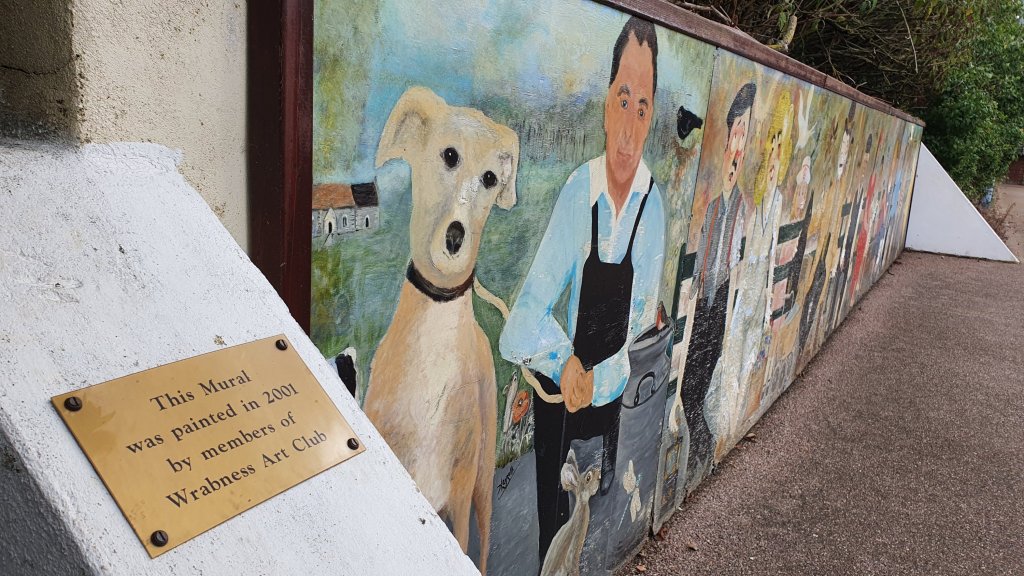
Wrabness has a few prize nuggets of history about it considering it’s size (small) and location (remote). For many years, including the two world wars, it’s coastal depot stored many of the nations sea mines that were laid in the North Sea and English Channel to defend the mainland from invasion and attack.
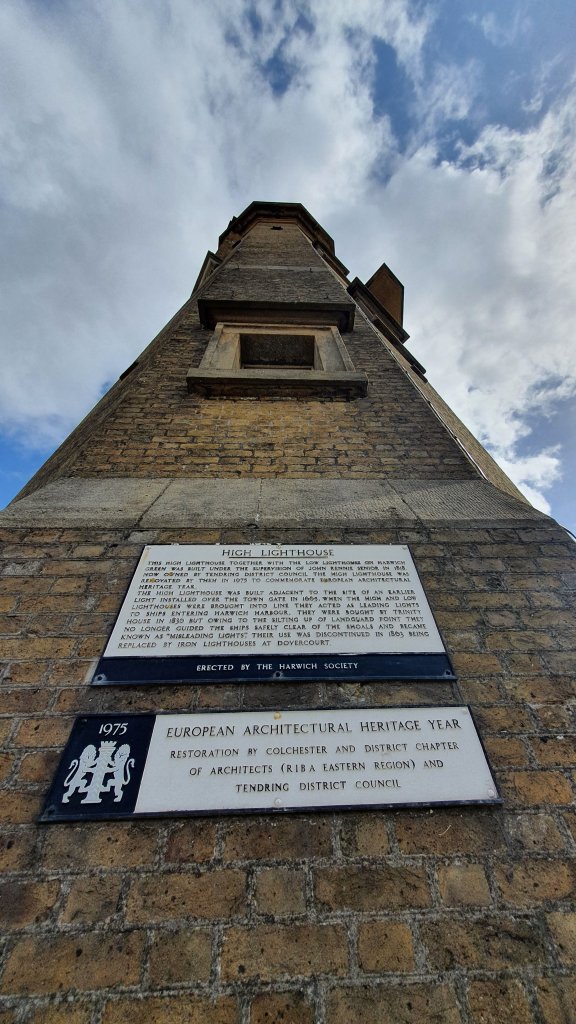
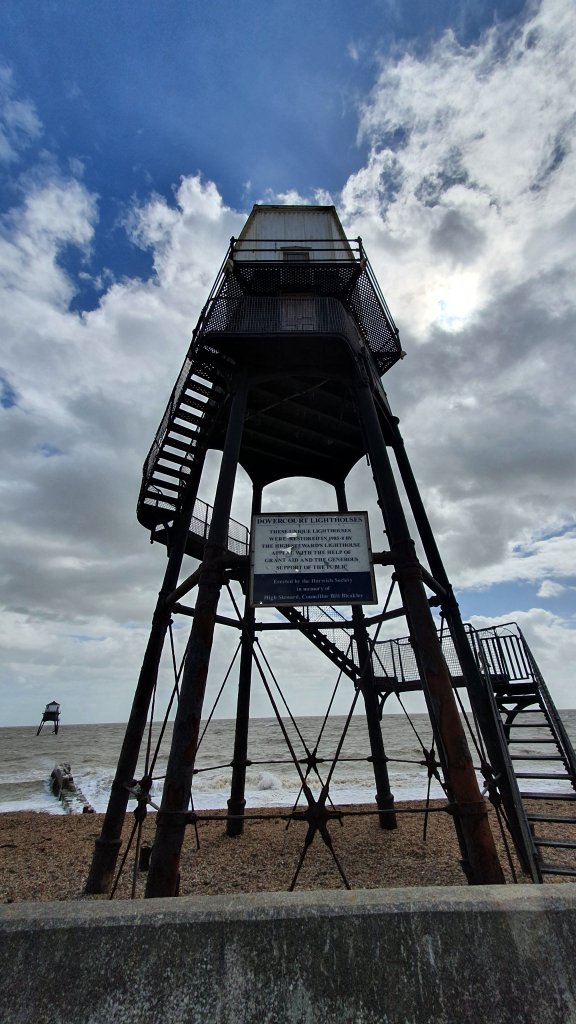
The Essex Way starts (or ends) at the High Lighthouse in Harwich. Together with the Low Lighthouse just a stones-throw away, it would guide ships into Harwich harbour. As the channel silted up they became regarded as ‘misleading lighthouses’ and we’re fully decommissioned in 1863.
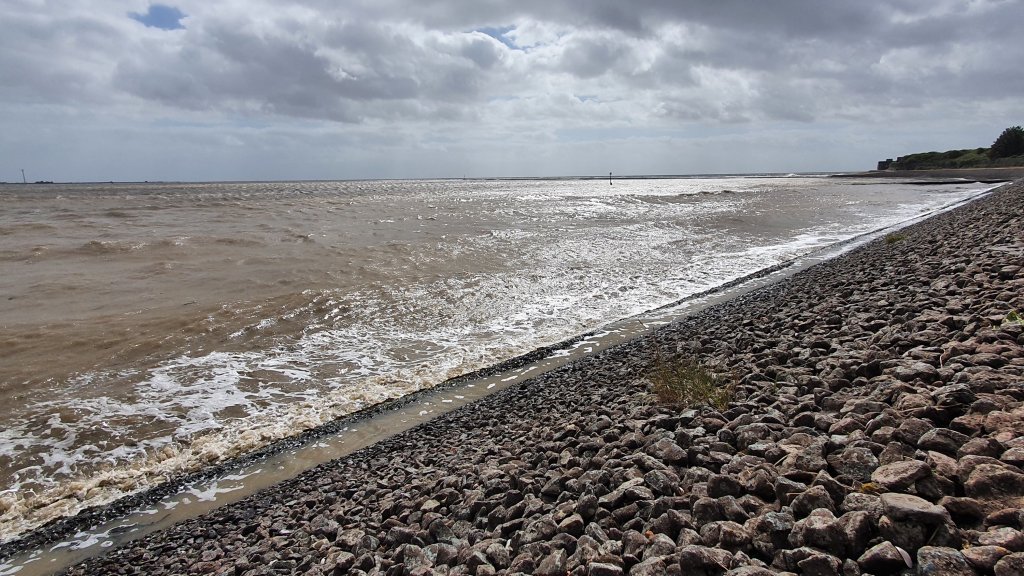
The wind is head-on walking south along the coast of the North Sea. Sand on the promenade prickles my shins and even manages to get into my closed mouth. My sunglasses protect my eyes from it, but fog up with a salty film from the fine spray in the air. The waves are battering the sea wall.
The Dovercourt lighthouses replaced the two at Harwich as the guiding lighthouses for Harwich harbour in 1863. They are quite imposing structures, looking otherworldly like something from War of the Worlds, and were technologically groundbreaking at the time.The breakwater at Beacon Cliff is doing it’s job today. Calming the wind-whipped waves of the North Sea. Harwich harbour deals with nearly 700,000 passenger movements and every year. It handles 40% of all traded goods that comes in and goes out of the uk.
The wind also affects the light. I noted a patch of sun chasing the train up the track towards me earlier. Shadows of gulls being pushed sideways grab my attention. Now the swift-moving clouds allow the sunshine sun in and out. The heavily stirred sea is a trendy Farrow & Ball type colour. When the sun smears it with light it looks freshly painted. What would you call that shade of grey-brown?
1.50pm Stopped at Ramsey and a well-deserved pint (well I think so) at The Castle. Ramsey is recognisable from a distance due to its (now reworking) windmill. It’s located on the highest point for obvious reasons and was made in Woodbridge, Suffolk in 1842.
When I am walking in the countryside, every so often I have occasional moments of sheer bliss. Excitement overwhelms me and I stop still, even forgetting to breath. I have frozen on a path next to a sun-soaked field of grass where at least a dozen swallows are simply showing-off with their low-level aerobatics whilst catching food at the same time! And the cherry on top? A kestrel has just launched from under my nose into the sky and is swooping and sloping; into the wind, away from the wind, alongside the wind. I am also surrounded by butterflies and other insects who all seem to be crammed into the sheltered side of the hedgerow. Flipping heck, right place, right time.
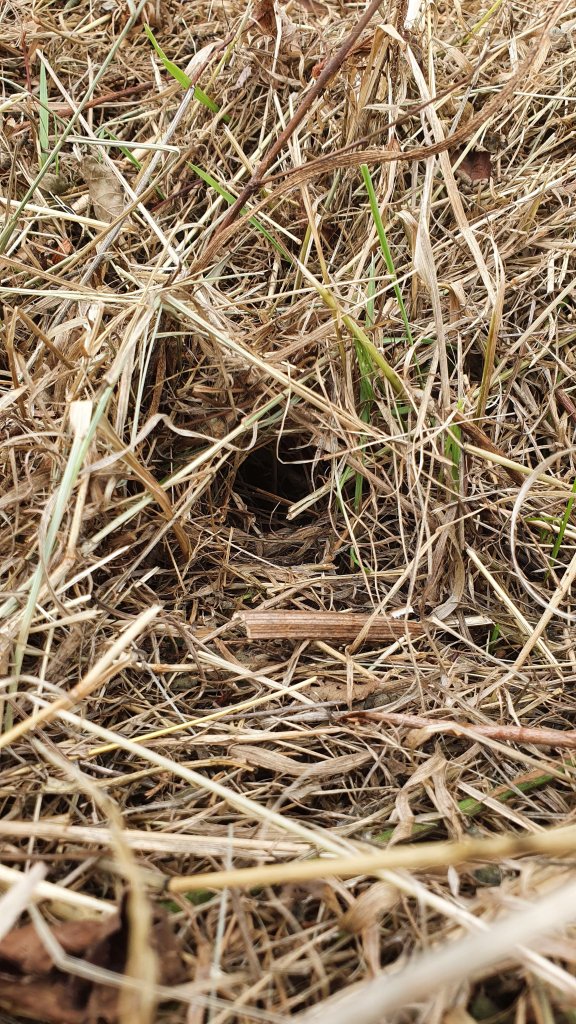
The grass on the side of farmed fields have been cut revealing the small holes creating a network of runs for harvest mice.
Sat on a bench in Copperas Woods. The word Copperas possibly derives from the medieval English for the ferrous oxidised green of copper. The range of greens on show today is amazing. I have mentioned before how we tend to take trees for granted. They are a walkers best friend providing shelter from rain and sun and as a landmark to get a sense of direction and distance. But trees also protects us from the wind. I am sat in a clearing in the middle of Copperas Woods. I can hear the wind all around me, coming in from the distance like a breaking wave, getting nearer and then crashing through the boughs immediately around me. But here, on this little island, I only feel a slight breeze on the back of my neck. The trees have taken the full force. Above me, the wind has also brought in the grey clouds, time to move on.
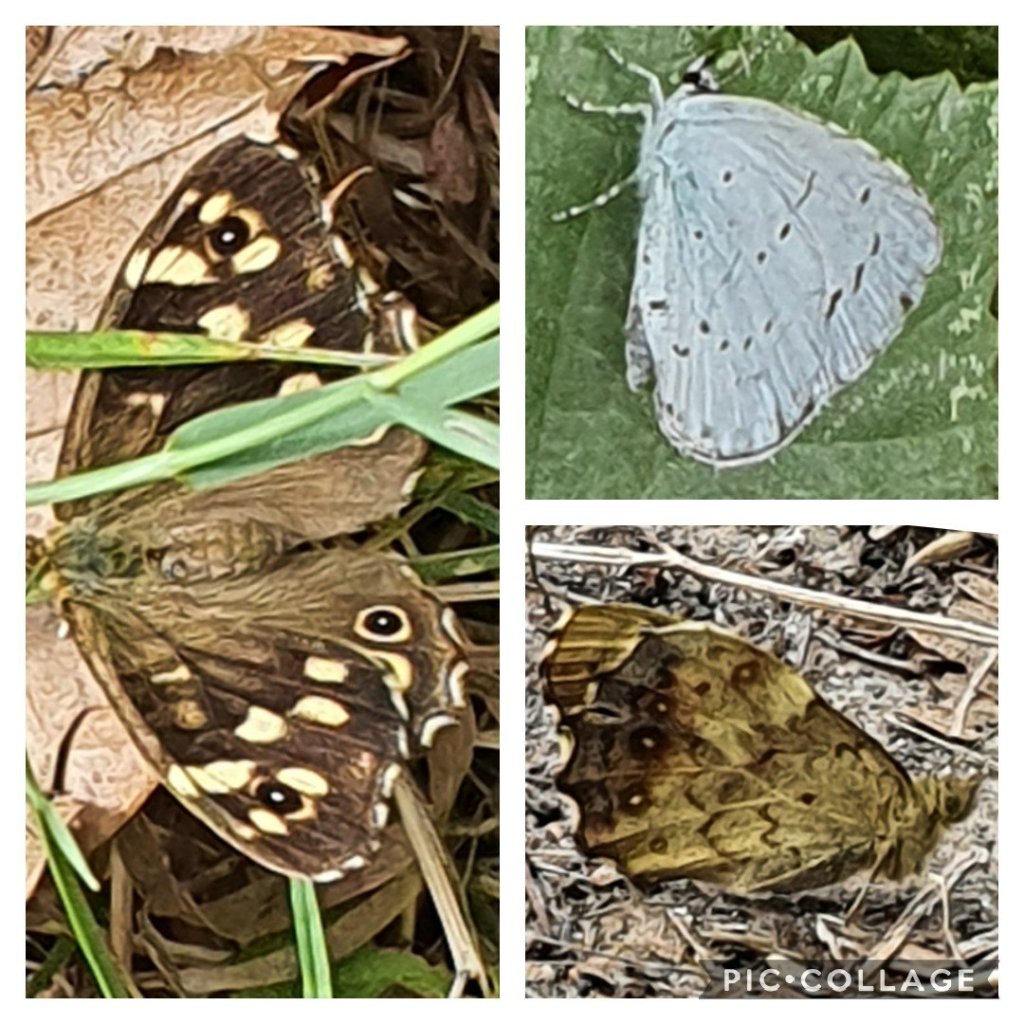
Two different butterflies spotted today. Speckled wood (Pararge aegeria) open and closed, Holly blue (Celastrina argiolus).
Walking along and looking up is a lovely thing to do. I remember making a point of doing this when I used to live in London. We naturally look at what is at our eye level and obviously in front of us most of the time. We also look down a lot. But not much looking up. It feels good to look up. Looking up I notice that the tree canopies are bending this way and that. Their leaves are all a lighter shade of green underneath? It’s odd, like seeing the hull of a boat or clouds from above. I’m not used to it. The trees pump more chlorophyll to the upper surface as is faces the sun and will be able to turn more sugars into energy and growth.
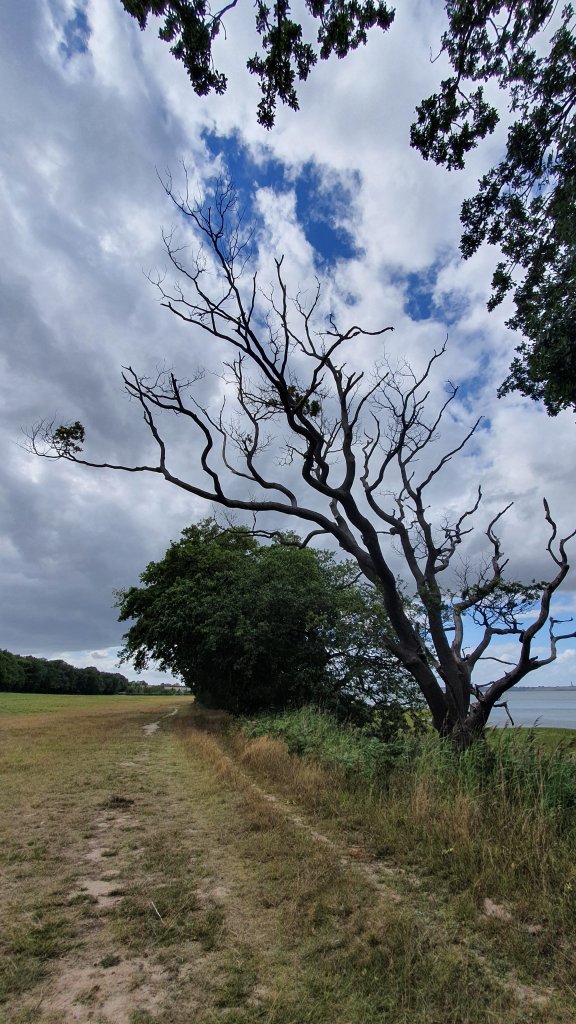
What is it about these occasional dead trees dotted on the landscape? They have a sadness about them.
Emerging from the woods and I’m nearly at the end now, walking alongside the Stour estuary. Along this open meadow space (where we have walked a few times now), I always get a good feeling. Woodland to my left, beyond the grassland. To my right a strip of marshland that gently bleads into the estuary. Beyond that, Suffolk.
These strips run parallel to each other and provide a range of visible textures. I love the fact that each one is a different ecosystem too. Seabirds, alongside meadow and woodland birds for example. So today, I look over one shoulder and see various gulls, waders and a Great Crested Grebe diving for fish. I look over the other and see a Green Woodpecker flying in frenzied shallow waves, some crows and a Magpie. The wind bends the oaks and beech, sways the willows and hornbeam, and flicks the young saplings who seem to be enjoying it the most.
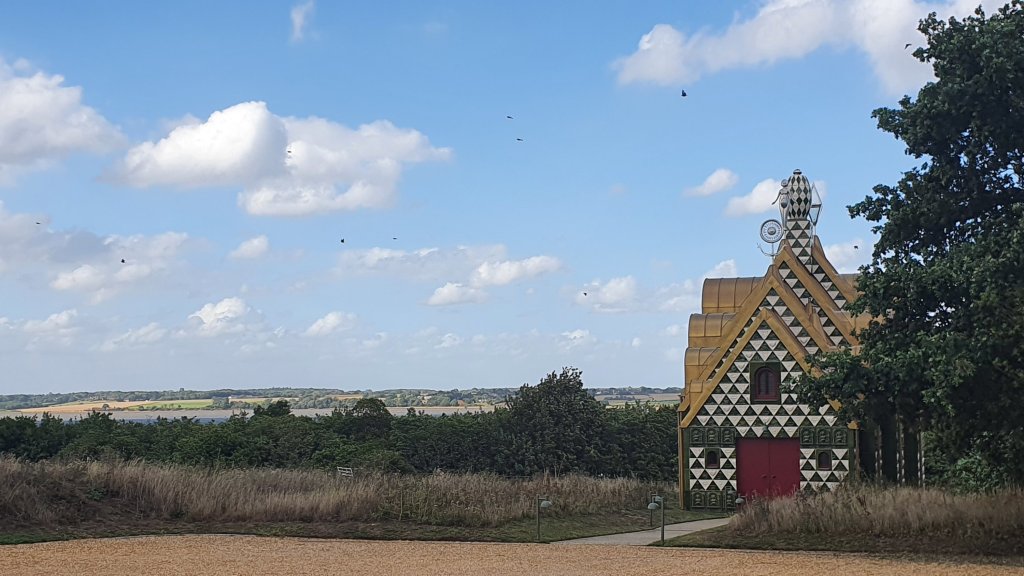
The End. Looking back at ‘A House for Essex’. The end of part one of this walk. Part two will pick up from this spot next week hopefully.
4.30pm The end if this walk as I arrive back at Wrabness and alongside Julie’s house by Grayson Perry. It’s dedicated to a fictitious single mum living in Essex who tragically dies after being run down by a delivery driver on a moped. The story goes that Julie was born in Dagenham and was a hairdresser in Colchester until her untimely death.
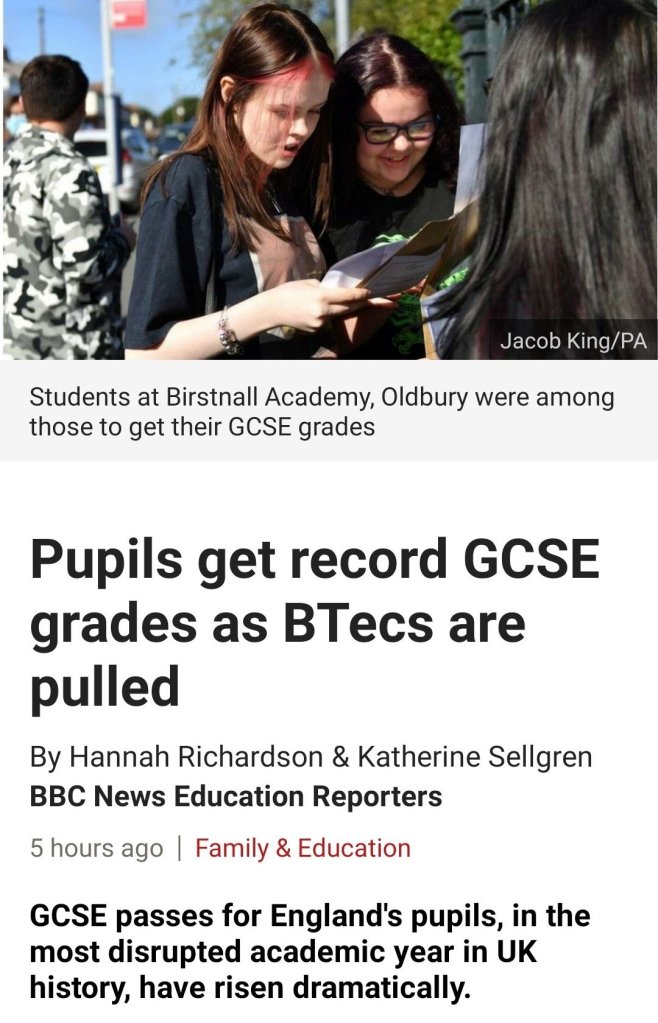
GCSE results day and Adora has done brilliantly. It’s all a tad bittersweet though as there have actually been no actual exams sat, instead the grades have been based on teacher assessments alone. The actual term is Centre Assessed Grades or CAGs.
Regardless, she has passed every subject with flying colours. The highlights being a 9 in Religous Studies and 8’s in English Literature and Design Technology (where her focus was textiles). This now sets her up perfectly for starting A’ Levels in a few weeks time.
We’ve just got back from having a meal at Wagamama’s in Colchester yo celebrate. Considering it’s a warm August evening, the town centre was very empty. More and more shop fronts are empty with only the bleached shadows of shop name signs as reminders of what was once there. Names that have been mainstays of high streets up and down the country for decades.
In recent times the high street has been changing. As more and more is purchased online shops that you walk into have been less desirable. The COVID 19 pandemic has accelerated this as companies are forced to cut costs. As they have disappeared, so new bars and restaurants have filled the spaces. Until now. People are choosing not to eat out, certainly those with money to spend.
The young are less fearful but don’t have the disposable income, the older are at greater risk of more serious consequences if they were to contract it. The lockdown closed access to any restaurant or shop and has been the nail in the coffin to what was already a fragile part of the economy. People are losing their jobs and the young, in particular, are finding it hard to get work. If people don’t eat and drink, staff are not needed; if they don’t have work, they don’t have money to spend etc etc. The impact of the virus is right there, clear as day.
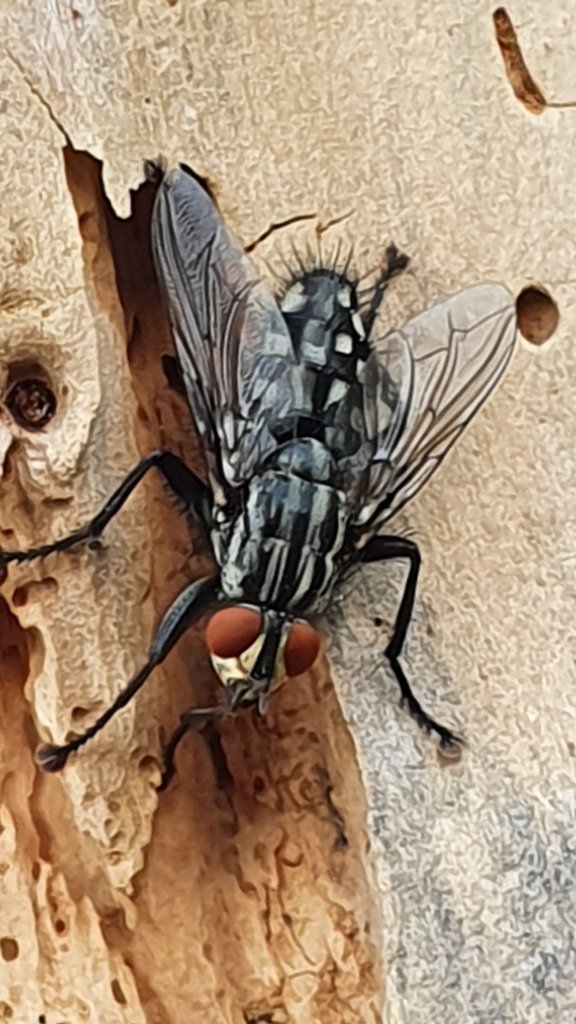
Totally unrelated to the topic of today’s post, I saw this common flesh fly (Sarcophagidae) on the side of a tree in the sun today. Just amazing what a camera in a phone can capture. These little treasures lay their eggs or even live maggots into rotting carcasses or dying creatures.
Adora’s generation risk being known as the year that didn’t sit exams and got over-inflated results. But, wait. Let’s look at that. The algorithm that was designed to take the CAG and adjust it was floored. It downgraded the poor by knocking down students grades based on the previous record of the school they attended. Wrong. So, after a U-turn by the government, they are now getting a grade based on what their teachers who have taught them for the past five years believe they are at. They have evidence to prove it in their books and their mock exams. We all know that sitting a formal test knocks marks off a student – they run out of time, misread a question or panic. So, I ask, what is the most accurate assessment if what a person truly knows and understands? The teacher or the test?
Now, we look to the class of 2021. Stanley will be sitting his A’ Levels. He has missed over a third of his first year. He has studied diligently from home but it’s not the same. His second year (and Adora’s first) will start in a few weeks with a part-time timetable of blended learning; some in college, some online from home. He will then be doing his mock exams and completing his application for University. Then he sits his exams next summer. Something will need to be done to those exams to make them fair. Surely, this must include trusting our teachers to grade some of this once again? It all comes down to trusting a system that will be fair and accurate. Unfortunately, we need to be able to trust the current government to make decisions that will get this right. I would grade their track record a very firm ‘U’.
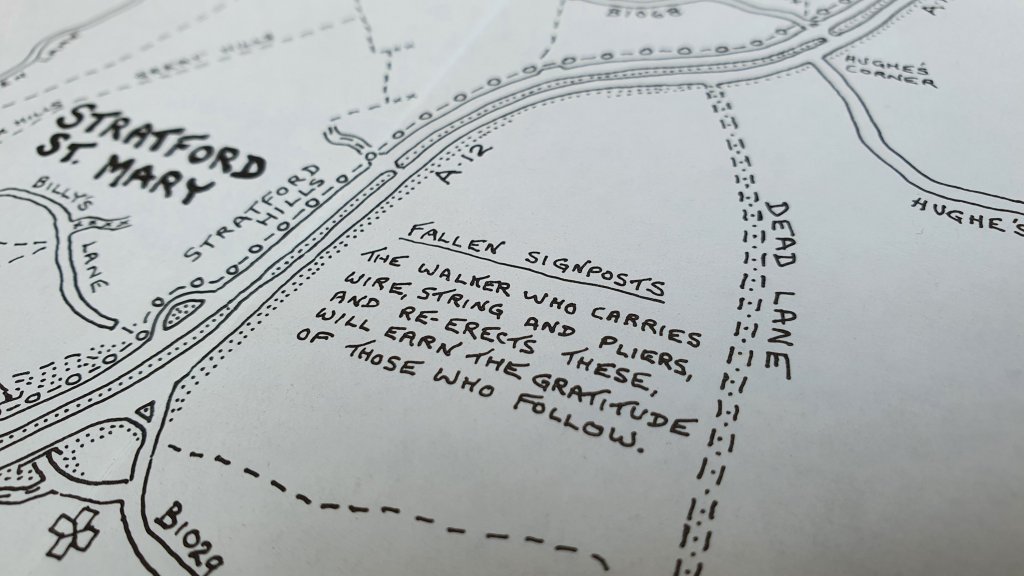
In yesterday’s post, I mentioned about walking in my local area. How these walks during and since lockdown, and since having Mabel, have helped me appreciate the world on my own doorstep. Also, importantly, to know where I can and cannot walk. The other week a friend mentioned how his collection of simple maps by Wilfrid George are little gems that remind him of his time living here. Wilfrid created these maps as part of his ‘campaign’ to keep public rights of way accessible for all. Attending parish council meetings, to raise awareness of overgrown or inaccessible footpaths and bridleways was where Mr George started.
Wilfrid George is a quite extraordinary man. His name is seldom recognised when mentioned, yet his maps appear in many, many cupboards and drawers throughout the east of England.
He was born in London in 1929. And, having been evacuated to his aunties house in Beccles, he drew his first map so that he got to know the area. He did this wherever he lived and loved to note the local names for different paths and cut-throughs.
The simple, green paper band around each map makes them instantly recognisable in shops and tourist information centres throughout the region. As does the hand-written headings.
After leaving school in Framlingham, he followed in his father’s footsteps as a pharmacist ending up in Halesworth, Suffolk again. Then to Aldeburgh after he got married in 1954 where he lives to this day.
His memory is remarkable. In chapter seven of the interview with him by Aldeburgh Historical Society, he recalls buying a motorcycle (a Panther 350) from one of only two motorcycle shops in Norwich in 1951. He can not only remember the exact route back from Norwich to Halesworth, but can recount the two times he stalled the bike and where. I can just about remember what I had for dinner last night.
His desire to keep pathways and rights of way open and accessible to everyone is a campaign and his map notes encourage us all to do our bit.
He left managing his last pharmacy in Aldeburgh in 1985 to start making maps. I love the way he describes how he didn’t enjoy his time in Aldeburgh due to the “demanding retired element” that lived there and would visit his chemist and be so needy.
So, he started by drawing a simple map of his local village and surrounds, as friends had requested one – he printed 50. The map covered two sheets of foolscap which he then glued together. Demand increased and soon he was drawing maps of an ever increasing number of areas where people enjoyed walking. His maps are simple lines, some annotations and no colour.
Brambles have clearly been his nemesis as this prompt appears on every map.
Oddly, I have just been contacted by the Ramblers association, asking if I would like to join. Wilfrid has been a long time member of the Ramblers and explains how, if you’re passionate about something, and there’s an organisation as passionate as you are, then you should join it. They will always need your support.
He talks of how, as adults, we should see ourselves as custodians of the footpaths, bridleways and other rights of way around us. We have a duty to keep them open and accessible for the younger generations who cannot conceive of their importance yet due to their age.
So, approaching the grand age of 91, Wilfrid George has sold well over half a million maps now. Any serious East Anglian resident will have at least one of his maps, usually missing the little green paper band across the middle. And when asked what the secret to a happy life is “that you’ve always got to have something to look forward to – and there is always something to look forward to in the garden.” A wise man.
Thanks, Sean. You provided the inspiration for this post.
It’s been a mixed up day today. I have only been outside to chuck a few balls for Mabel in the back garden and then for a short local walk with her and the family this evening. The Great Spotted Woodpecker paid a few visits to the peanuts this afternoon after the lunchtime thunderstorms.
I popped next door to help my neighbour with her tv. My other neighbour was there too, and we talked about the village, planned developments, traffic and a bit of this-and-that.
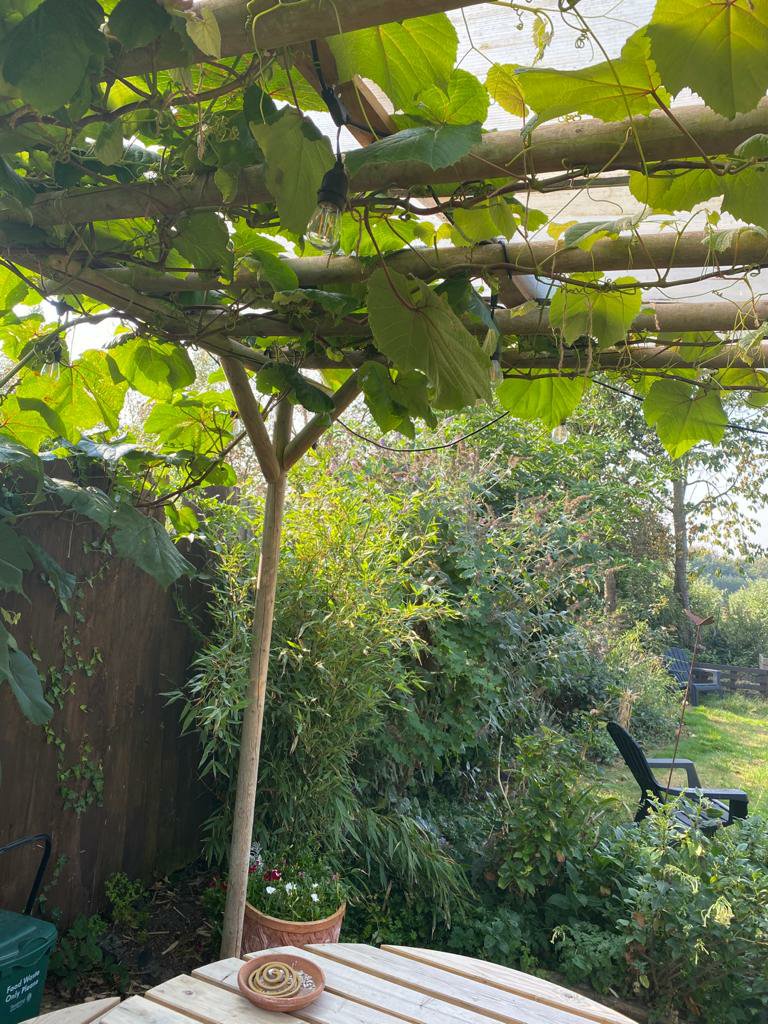
The vine at the bottom of the garden has really filled out under the covered pergola. We call this ‘the pub’, where we take a gin and tonic or a beer to enjoy some quiet, outdoor time. There might be grapes next year.
Our village is growing, with new houses popping up seemingly everywhere. Ardleigh is a big geographical parish and, unlike the villages adjacent to it that are seeing large estates going up, we seem to be getting a few here and a few there. But they all add up. So, I am not a ‘nimby’ type, I fully appreciate that affordable houses need building. Everyone, regardless of income, should have somewhere to live. But I do worry about the planning permissions that are granted – so many big houses. Every patch of land built on is another patch of land covered over. I was relieved that modern houses, regardless of size, seem to have very little garden. But the more houses that are built, I realise that that’s not so good.
I’ve decided that I am going to get involved with the local parish council in some way. My neighbours have been encouraging me to do so for about a year now but my Monday night footy has always clashed with the meetings. I owe it to myself and to my kids. I realise that sounds sickeningly righteous. But hear me out.
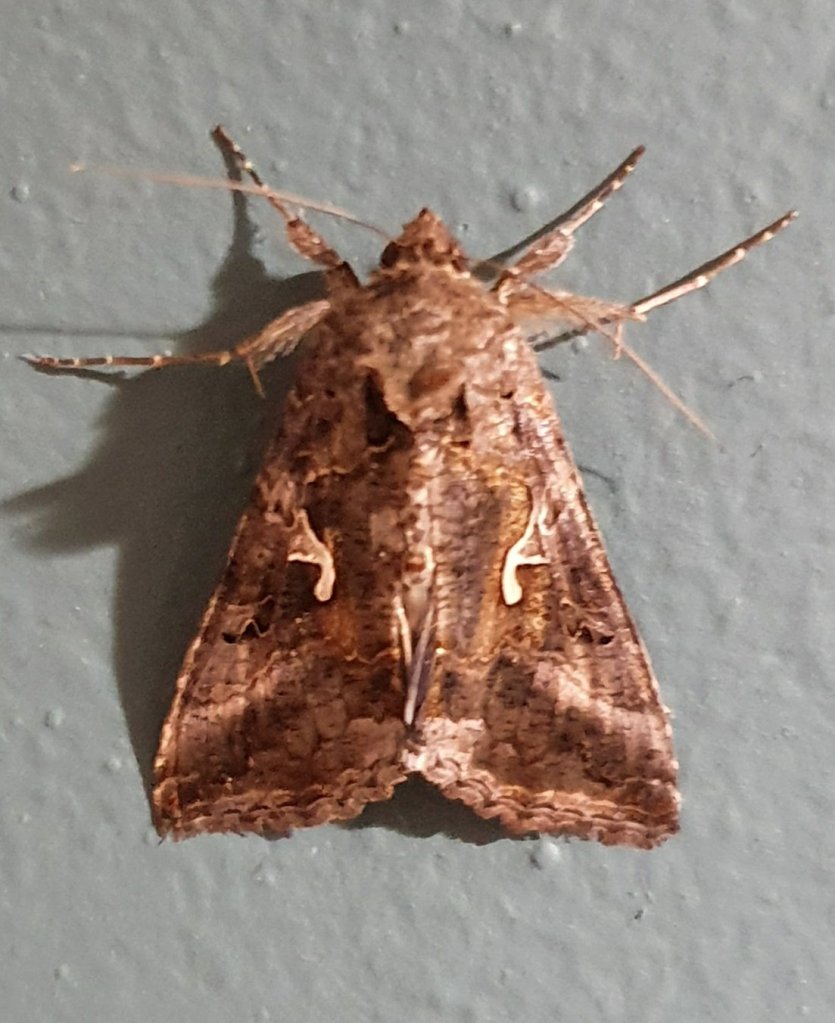
This beauty was in our house this evening. The Silver-Y moth (Autographa gamma), one of our most common moths but each one precious.
I know what the local area has given me these past few months and, in particular, how our own daily walks, some short and some longer, have provided an essential outlet for some peace and a sense of place. Mentally and physically, they have been good for me.
I have recently listened to the audio interview with Wilfred George, East Anglian map maker extraordinaire. He has dedicated much of his life to ensuring the Suffolk public footpaths near him are kept accessible for all to use. Ardleigh has a fragmented but extensive network of paths and bridleways along with some relatively quiet lanes and cut-throughs that I am sure, with a little planning, could be linked up to make a few circular walks for everyone to enjoy. Ok, so perhaps a lot of planning. Wilfred said that he believes that if you have an opportunity to do this, you should. It’s an obligation that adults have to the young people, and it’s democratic.





 The Bald Birder