Day 140

Friday 07 August

I am fascinated by our relationship with the coast. Not the sea, that is something I don’t have a real connection with, although I appreciate many do. I also love the fruits of whatever is harvested from it. No, its the coast that I find wonderful. The final mile or so of the dry world before it slips beneath the water.

This morning I watched a steady stream of brightly (but slightly) covered people of all shapes and sizes carrying what they could along the path to the beach. It makes me smile and is a wonderful sight. We are somehow, almost universally, drawn to the beach. This is despite sand getting everywhere, minimal access to water, toilets and the pre-struggle to get everything ready and lugged all the way there in the first place.

What I love so much about the beach is that once there, the only things to do are what you have brought with you or what you find there. No wifi, no distractions, nothing to buy. What I love in particular, about these Norfolk beaches, is the amount of space. The massive length of time it takes to walk from towel to sea, even when the tide is in. The beaches here are mirrored by the amount of sky above.
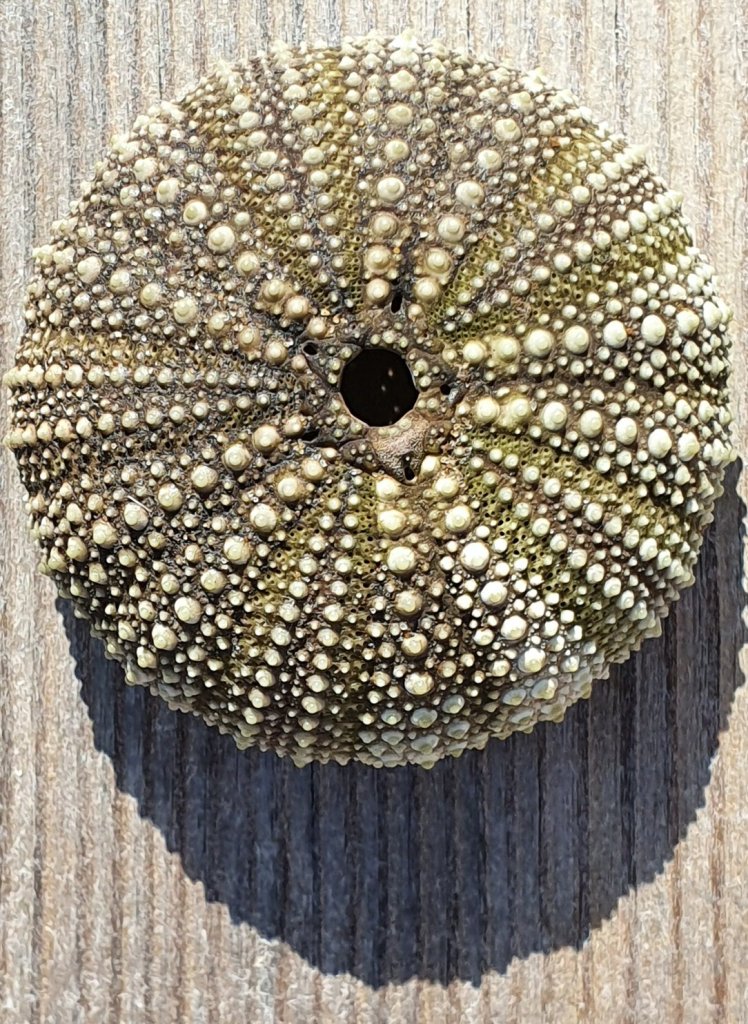
The common sea urchin (Echinus esculentus) has a shell divided into five equal sections. It has spines protruding from these follicles. We were amazed today by the symmetry and simple perfection and beauty of this shell. It made us wonder why something so practical could/would be made so beautiful at the same time.

I love the trinkets that you find and bring home. Reminders of ‘that great day at the beach’. I used to have collections of these from numerous trips when our children were smaller. Coming back to me with a shell they had found. I used to set challenges to find the smallest shell, the largest, the prettiest, the most magical. I used to whisper wishes into shells as a child and take them home. We have a string of driftwood sticks threaded together from our memorable time on ‘la Spiaggia Bianca’. My sixteen-year-old daughter brought a shell back to me at our beach ‘base’ when we were there earlier this week.
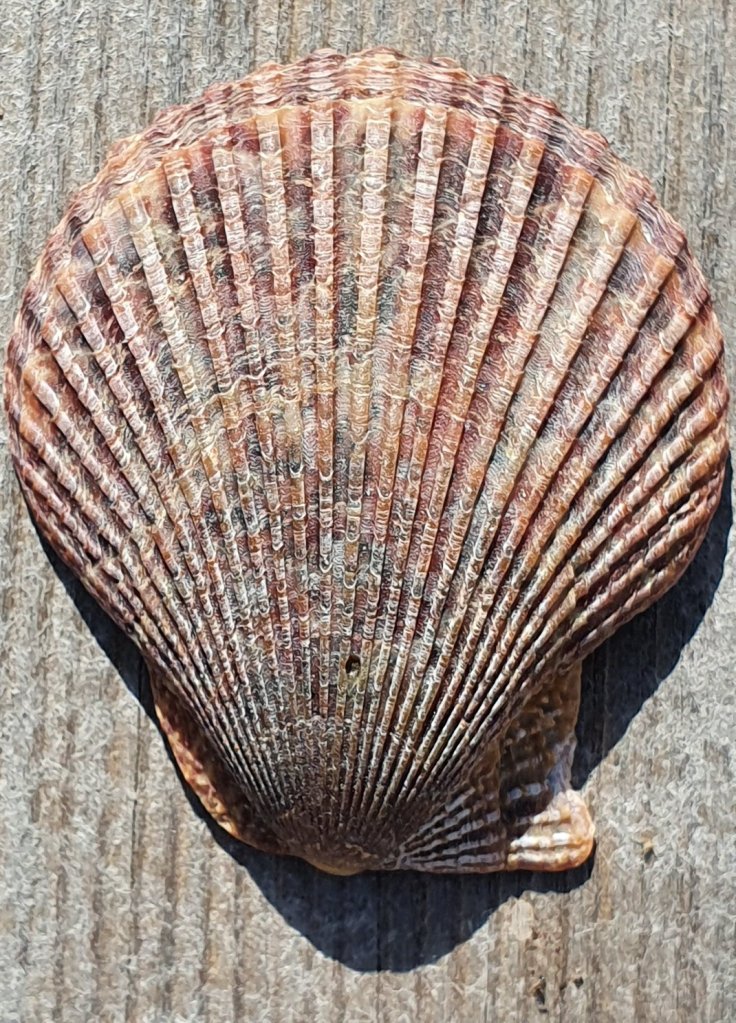
The Scallop shell was the symbol of Aphrodite in Greek mythology. The goddess of love and fertility.

Then there’s the tingly feeling of sun prickled skin, tightening, as you walk back to the car or wherever. The salty, tacky feeling of hands and hair and the warmth radiating from faces.

Our love of and for the coast is varied and deeply rooted. Far too many to explore in this single post. But the special memories that are made, handed down, and replayed on our beaches as children and as adults will go on and on.
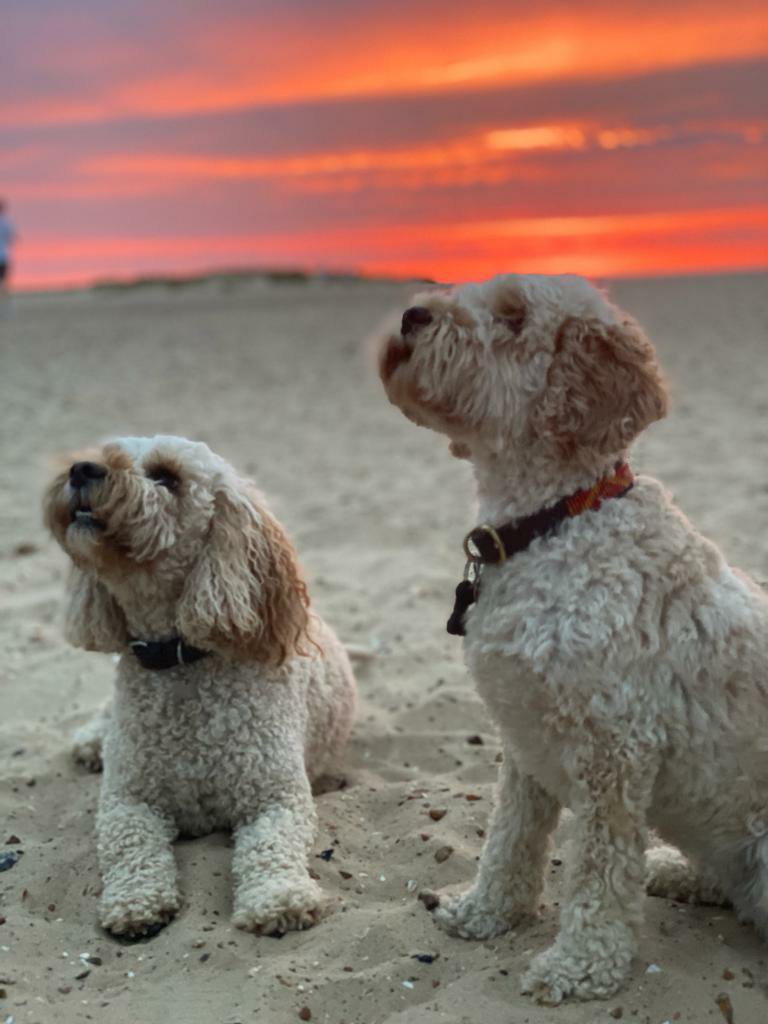
Mabel and Margo just before leaving the beach after sundown this evening.

Day 139

Thursday 06 August

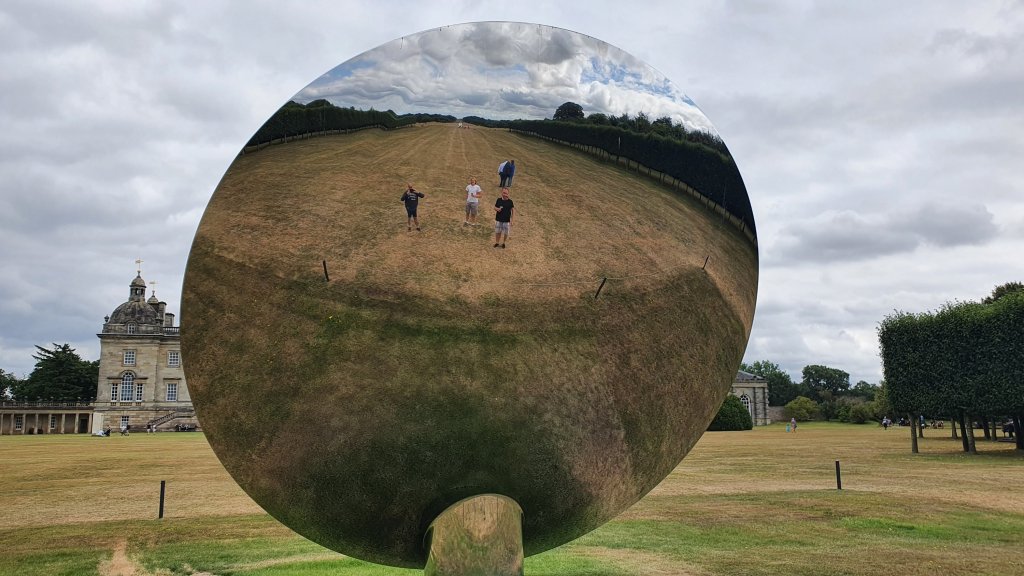
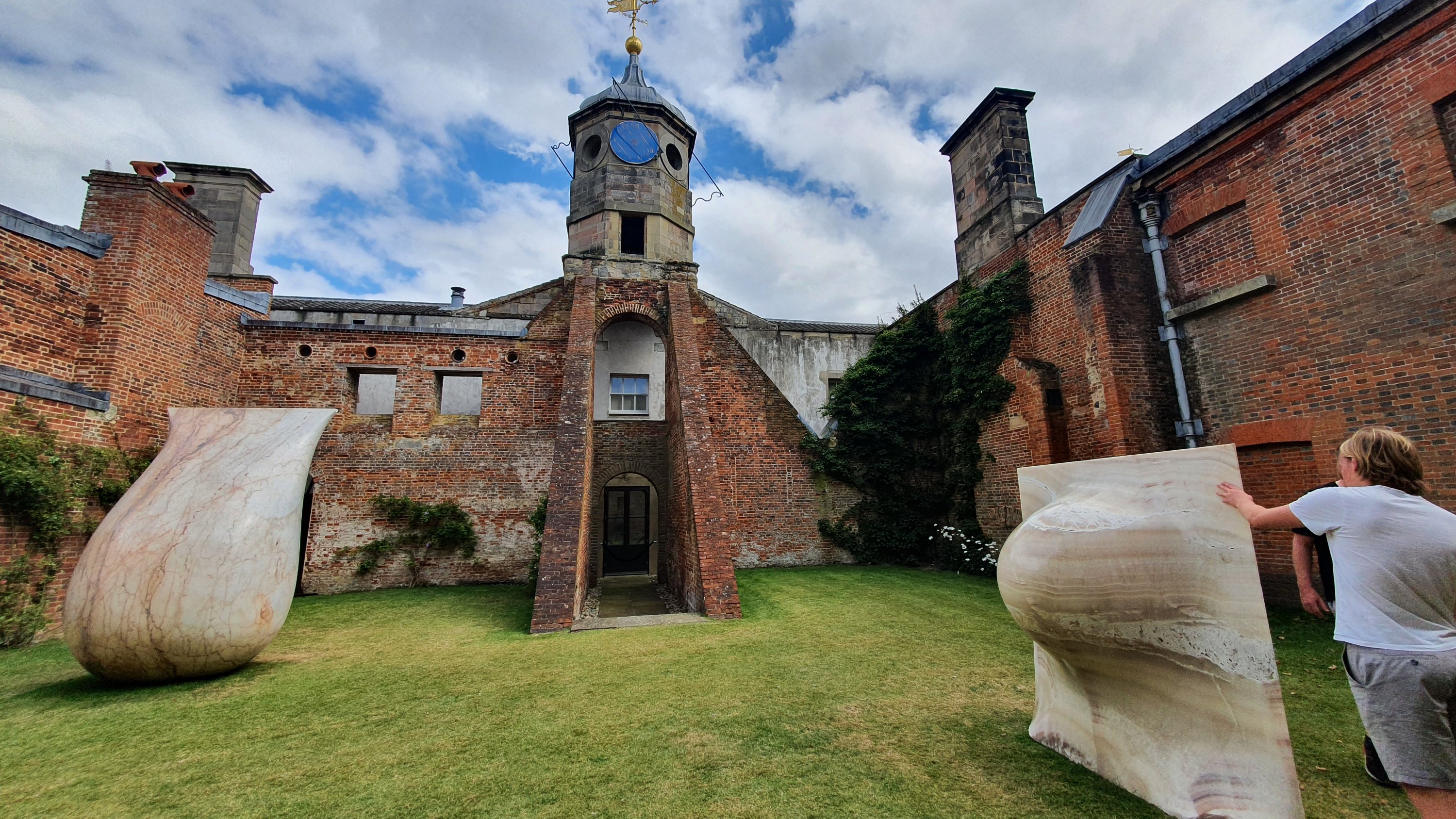
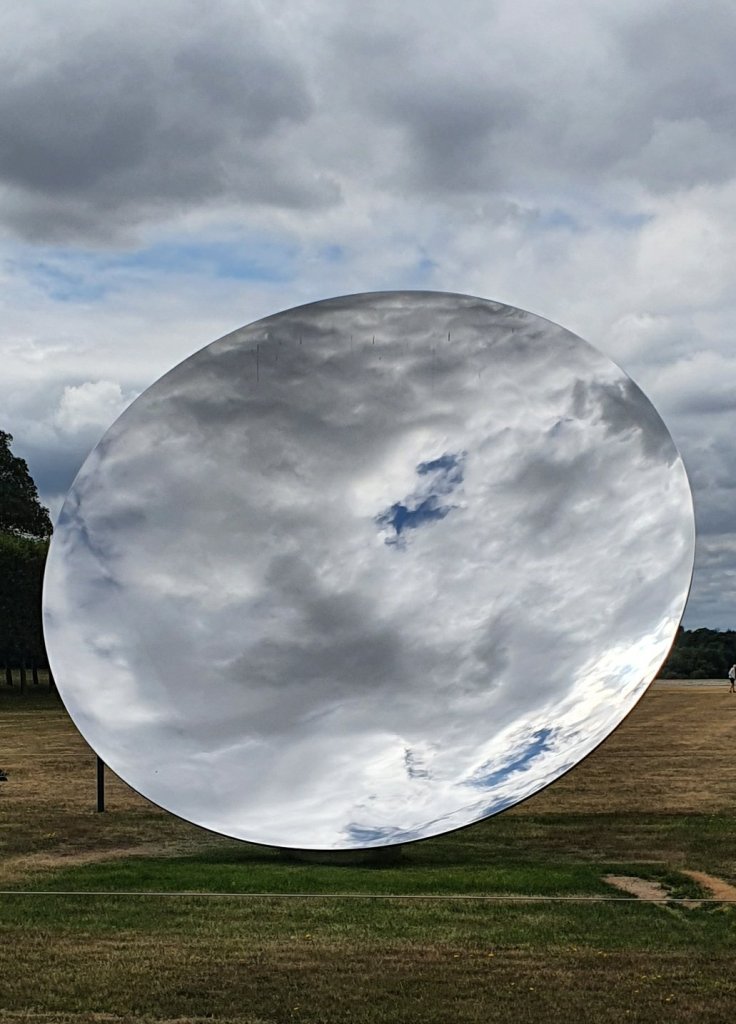
A different day out at Houghton Hall today to see the Anish Napoor outdoor exhibition. The majority of his sculptures in this collection are made from shaped and polished marble but the most eye-catching piece is certainly this curved metallic dish.

Sky Mirror (2001) – 10 tonnes, 20 ft diameter, polished stainless steel.
Reverse of Sky Mirror. Unveiled in 2001. Encourages a land and space odyssey.

It is pitched at an angle of around 60° to the ground making the concave face reflect the sky, whilst the convex face reflects the ground.

I have always found sculpture less accessible than other forms of art. A bit like poetry in writing, or jazz in music. It’s probably just a bit too abstract for my simple brain. Maybe it’s just a bit too up itself?

But that doesn’t stop me appreciating what it looks like, reads like or sounds like. I have always felt that the creative minds behind those art forms in particular are just, woosh (hand swished over my head). But, in my fifty-first year, I realise that whatever it stirs in you is exactly what it was intended to do. That includes, simply liking what it looks like or disliking it for no reason in particular.

The thing that bothers me most though is how inaccessible this exhibition and so much art is to so many people. The price of the tickets, its location and the difficulty in getting to it. Many families don’t have the disposable income to afford it or the means by which to get there. London is totally out of the question, this is not much better. At least kids tickets were free but must be accompanied by a full paying adult. The demographic was very white, very 50+, and the cars in the car park suggested that the vast majority were not struggling financially.

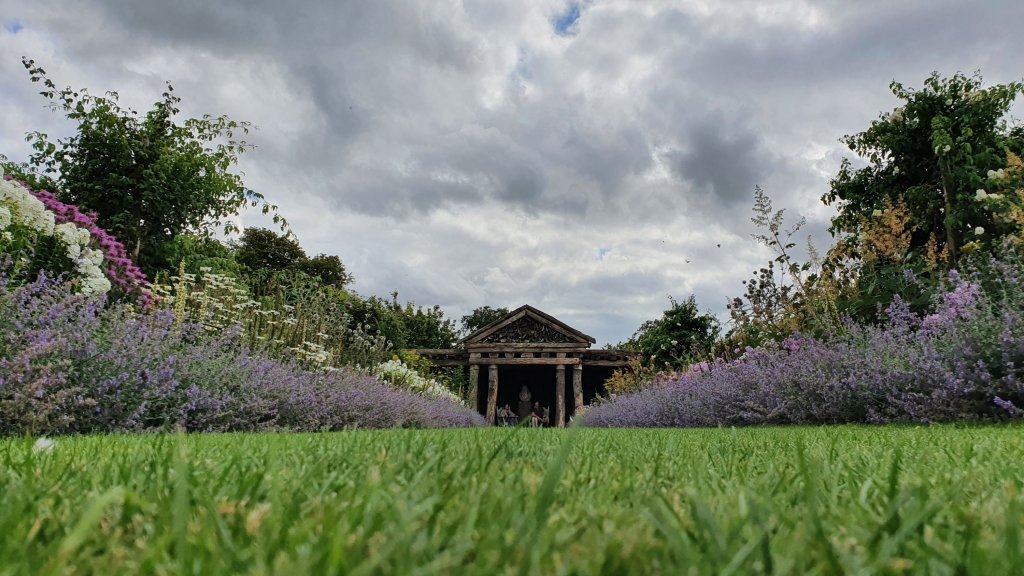
The gardens at Houghton Hall are beautiful.

We then spent an amazing hour in the gardens being bombarded by the August sights, sounds and smells of a plant spectacular. The fruits and vegetables, the roses and wisteria, the lavender and herbs. The bees and butterflies were having a ball. The water (and fire!) features were dancing in the sunlight.

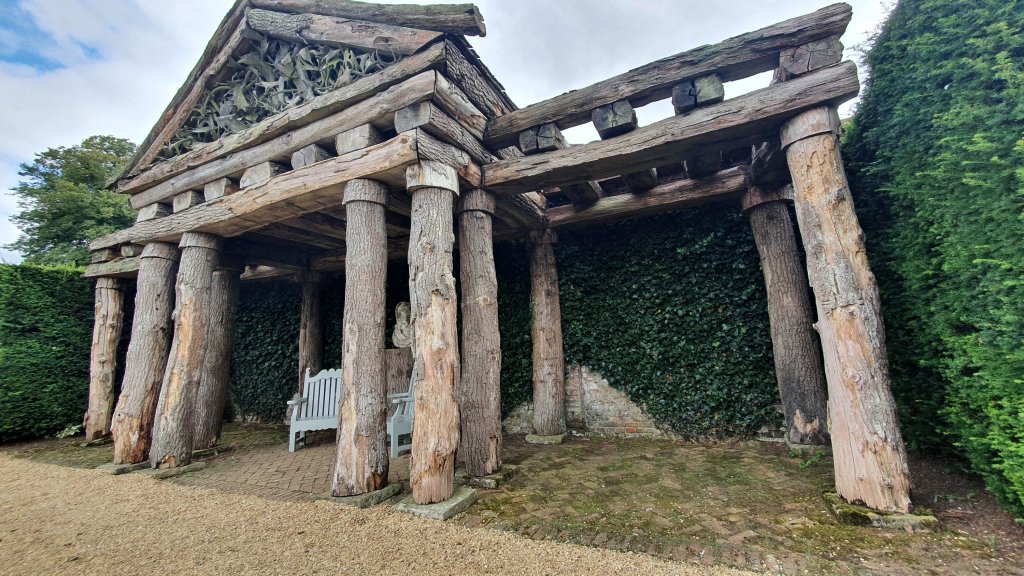
Made from tree trunks and deer antlers.

Then pizza, a beer and a walk on the beach with Mabel off the lead. The sunsets on the north Norfolk coast rarely disappoint. I realise it sounds cheesy but is there really anything more eye catching and thought provoking than a coastal sunrise or sunset?

And as we walked back along the soft sand, with our sandals hooked over our fingers, I realised how we have everything we could ever need.

Wells-next-the-Sea this evening.

Day 138

Wednesday 05 August

I have mentioned before how the things that are commonplace are so easily taken for granted. This pandemic has granted me time to stop and stare. And it’s the things that surround us all the time that are turning out to be the things that are fascinating me the most.

The common wood pigeon (Columba palumbus) is arguably one of the most successful creatures in the world.

So, I am sat outside supping my second coffee of the morning while the wind swirls around and the sun bakes down. This post is going to be a little homage to the humble wood pigeon.

1. Communication. The pigeon has a limited number of calls. I’m listening to the classic combination of five connected purrs as a wood pigeon one now sitting in the tree next to me. Bur-burrr-burrr-bu-bu. These can repeat and are the perfect background sound to an eyes-closed doze on a summers day. I love the way the repeat of this combination of notes often ends on the first one of a new ‘line’; Bur-burrr-burrr-bu-bu-bur. They have also communicated on our behalf too, but more about that below.

2. Taking-off and landing. I can’t help but think they are the clowns of entrances and exits. The clumsy way they crash into the trees to roost or flap hysterically when landing on the floor. And the mayhem of sound that accompanies them when they leave a tree is almost comedic. It’s like the comedy trip of an end of the pair performer.

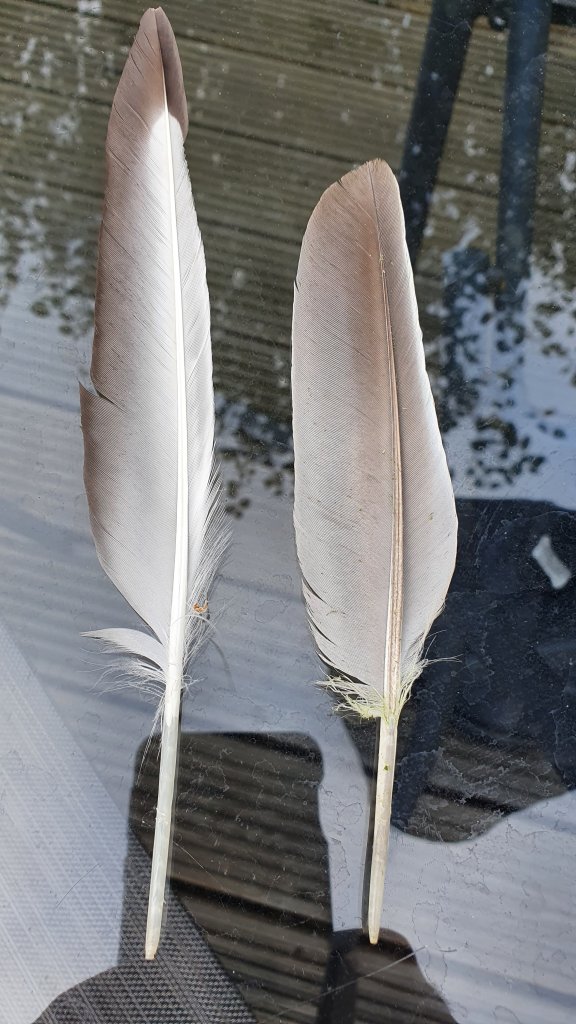
Flight feather and contour feather of upper wing.
Two pigeon feathers. Left – ventral contour feather provides body warmth and weather-proofing. Right – ventral semi-plume feather provides body warmth only.

3. Flight. The clapping of it’s wings as it steeply climbs high into an oncoming breeze then silence as it pulls back the wings ever so slightly, spreading it’s primaries, before gliding steadily down and leveling out. If it had a smoke canister attached (aka red arrows) it would draw the exact rise and fall curve of the coronavirus pandemic. They seem to do this for fun. They can be incredibly fast, they can swoop and corner with the best of them.

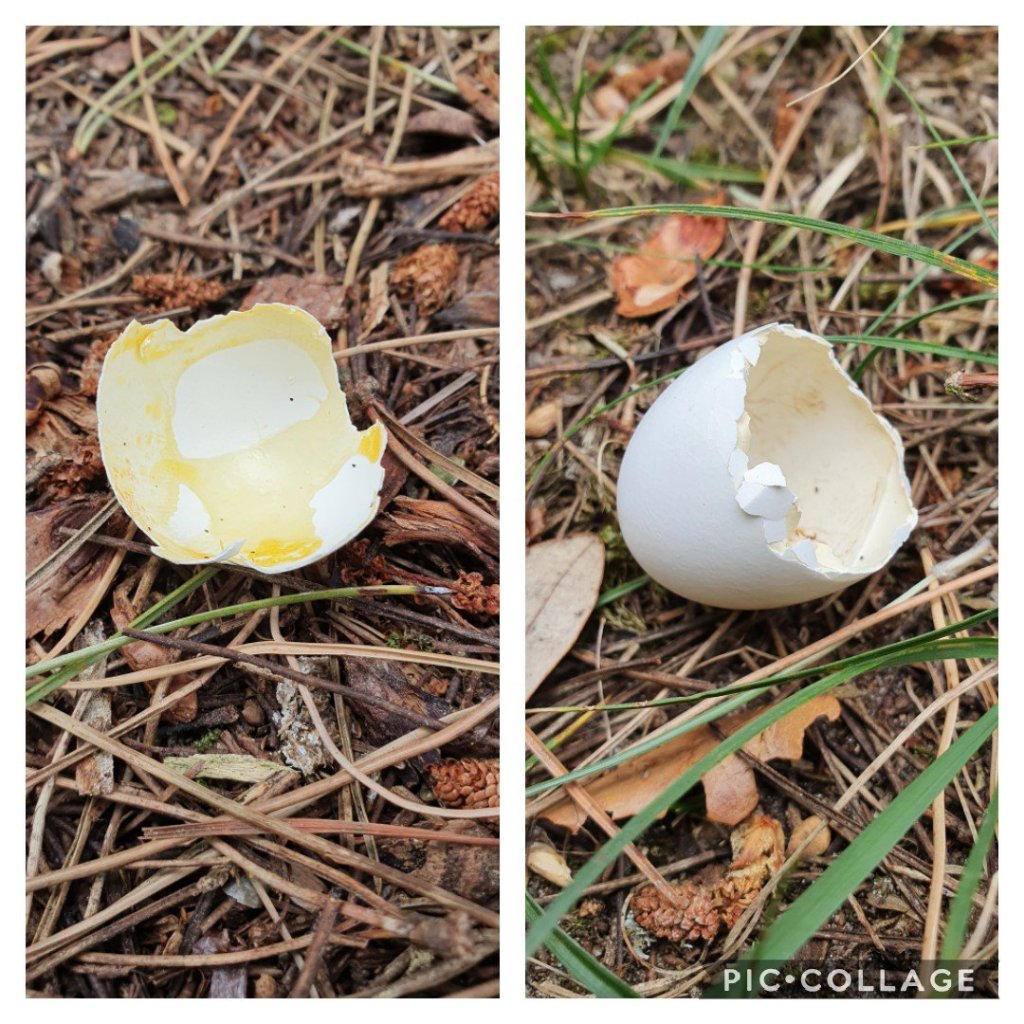
4. Success. They are such an adaptable and intelligent bird and their numbers are incredibly healthy. They live alongside us and benefit from this. They are also prolific breeders having upto five clutches each year. They tend to lay one or two eggs each time and both parents can produce crop-milk to feed the young chicks. Adults remove the spent white shells and drop them around 100m from the nests when hatched. This gives a decoy to predators that young are in a nearby nest. Their success means that others higher up the food chain also benefit such as the Peregrine.

Any white egg found on the floor is likely to be a pigeon egg. Any sign of yellow inside or uneven breaks suggests it has been predated. A more even break with veins inside? Most likely a successful hatch.

5. Symbolism. Pigeons and doves belong to the family Columbidae. It’s often said that doves are just pigeons with good PR, and indeed many cultures do not distinguish between them using on or the other word only. We tend to refer to the smaller varieties as doves. They have been well represented throughout the ages as bringers of peace and hope, and have figured in ancient Greek and Roman art. They are also prominent in Islamic and Christian texts.

6. Friends of ours. Pigeons and doves have been trained to deliver messages for us in some of the most dangerous of places and have saved lives. After the last two world wars they have even been honoured with medals for their service. Their are also plenty of people who race pigeons as a pastime.

So, here’s to the humble pigeon. I will never, ever take you for granted, my little friend.

Day 137

Tuesday 04 August

We’ve been with friends today on the beach and walking along the pathways of Holme-next-the-Sea. Conversations about this and that; the benefits of meditation, the positives from the Covid-19 pandemic, forest farms and apple orchard husbandry.

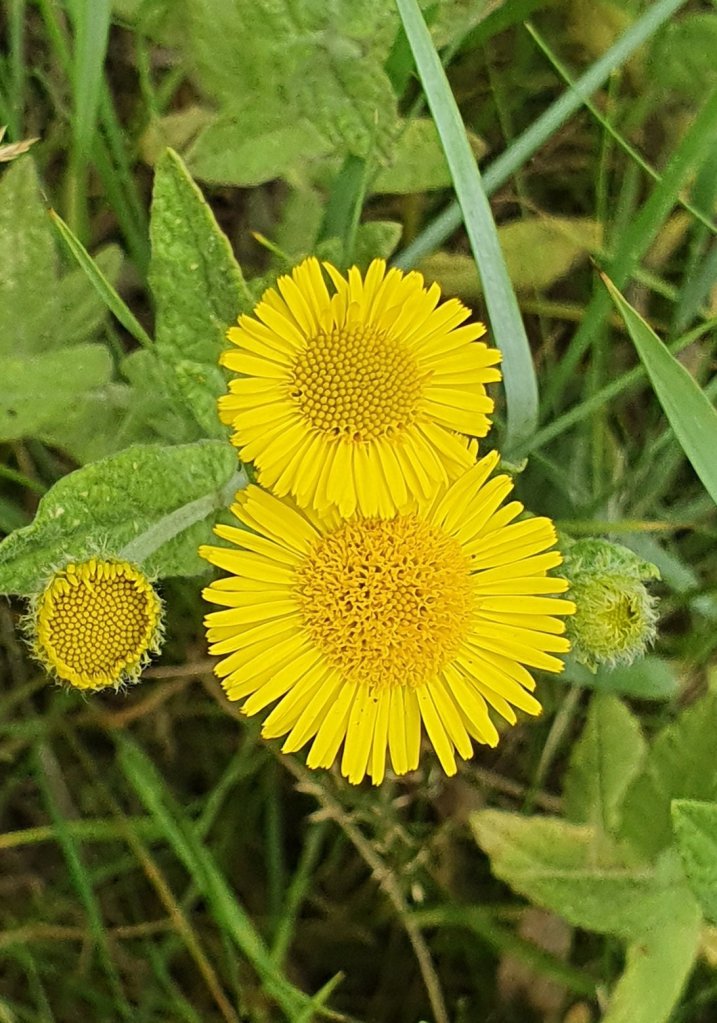
Coltsfoot (Tussilago fafara) is fairly widespread in the UK. It’s traditionally seen as a cure or relief from a sore throat. It’s Latin name means ‘to act upon a cough.

I’m taking a lead from my friend, Pete, who speaks so passionately about his plans to adapt his apple orchard to become more ecologically sustainable. He will be making use of layered, carefully selected planting under and around the apple trees. At the same time he hopes the annual yield of fruit will improve by the increasing number and range of insects that will be attracted. So, this post is going to focus mostly on the range of flora I’ve seen since being here.

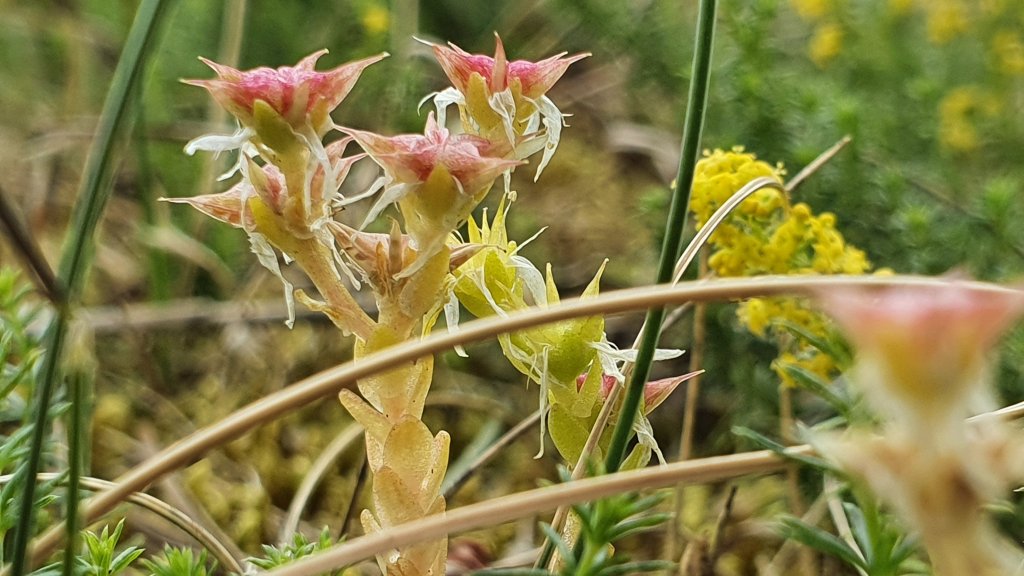
Biting stonecrop (Sedum acre) is a mini groundcover plant. It’s tiny flowers are a big draw for visiting insects and the leaves have a very hot taste.

We went out for a lively meal this evening, the first in 2020! We also had £80 taken off the bill through the ‘Eat out to Help Out’ scheme. Where the government pay for part of your meal to support the pub and restaurant industry.

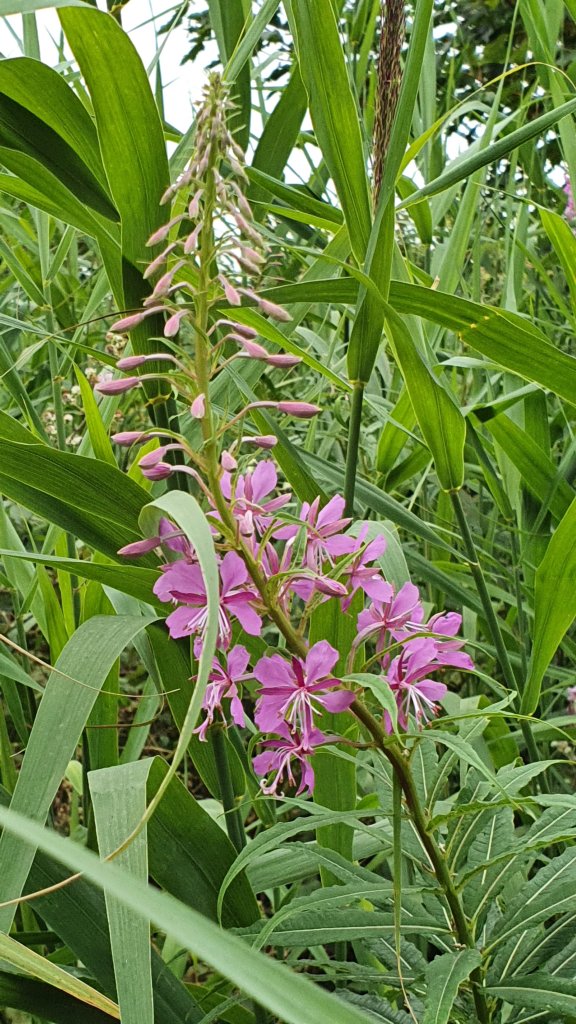
The Rosebay Willowherb (Chamaenerion angustifoliumis) an immigrant introduced to the UK from America in the 1800s. It has taken a very firm hold spreading north and west from the south-east corner.

On the journey home, along the dark lanes, we passed two deer which I believe were Chinese Water Deer. Before I came up here, three days ago, I had never even heard of them. Then we see a living pair tonight, and the two carcasses we found on the beach a couple of days ago.

Finally, as we arrived back at the caravan park, an otter ran across the road just in front of us. Another first for me. I have never seen one before and they are doing well in East Anglia over recent years.

Day 136

Monday 03 August

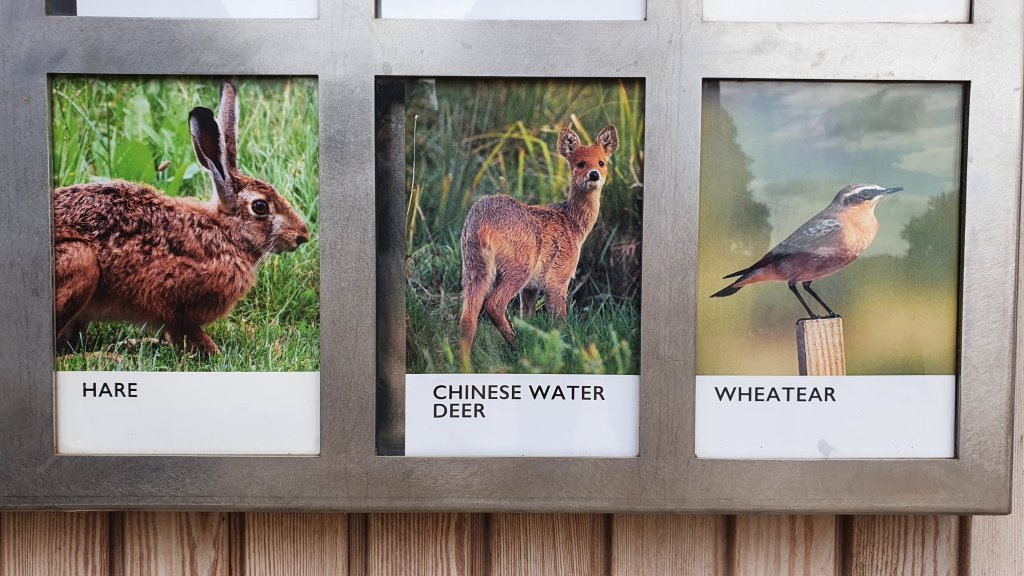
9.00am I think those mysterious carcasses found on the beach at Cley yesterday were young deer. Chinese Water Deer (Hydropotes inermis inermis) are reed bed dwellers that are on the at risk list globally, but have a fairly healthy population in East Anglia. I had never heard of them before, but they are one of the six species of deer that roam rural parts of the UK. The young deer are born in June and July which would correlate with these small bodies. They are sometimes called ‘Vampire Deer’ due to the pair of fang-like tusks that protrude down from their upper jaw. They don’t drink blood, by the way.

But still, the mystery persists of how they got there on the shingle beach?

A display on our walk today shows what has been seen recently around the Holkham woodland and marshes. This backs up my own research before our walk.

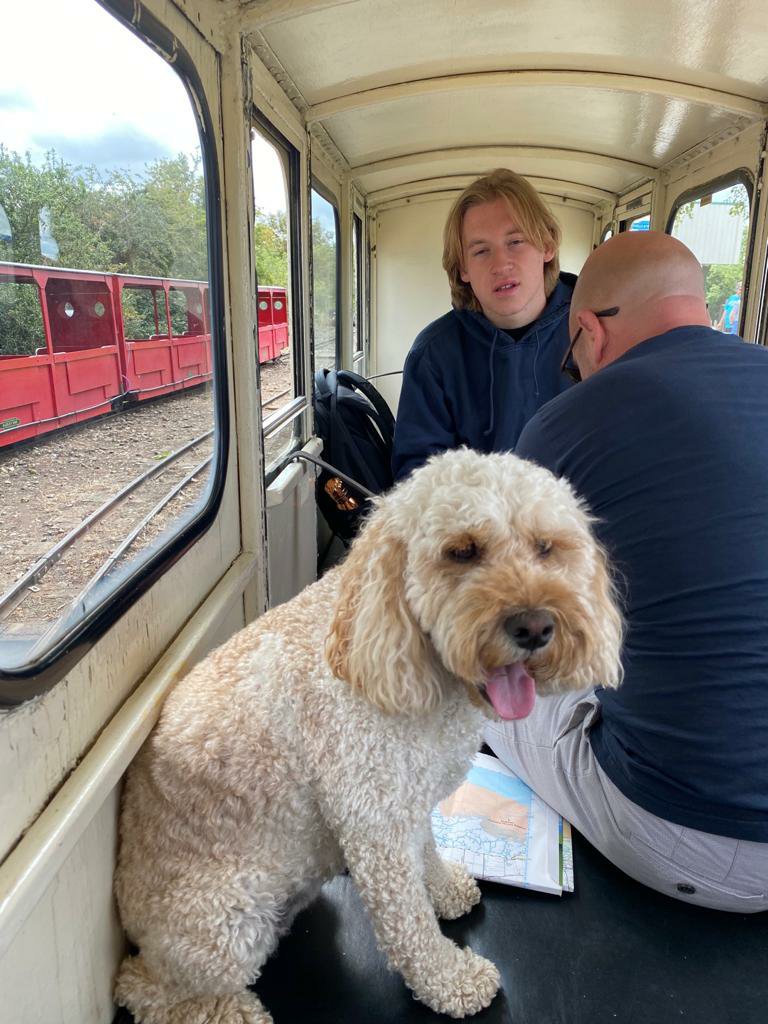
11am We are starting the day with a trip down memory lane/track. A round trip on the narrow gauge railway from Wells to Wighton Gap. The journey would normally go to Walsingham but the Coronavirus has meant they want to reduce the number of visitors to the village which is a Roman Catholic pilgrimage location.

Mabel was a bit nervous on the train this morning.

Midday. Then a circular walk to the Holkham estate. Packed lunches in back packs. The kids are struggling to be inspired today after our lengthy sojourn yesterday. But we are smiling and chatting and taking it in turns to hold Mabel’s lead.

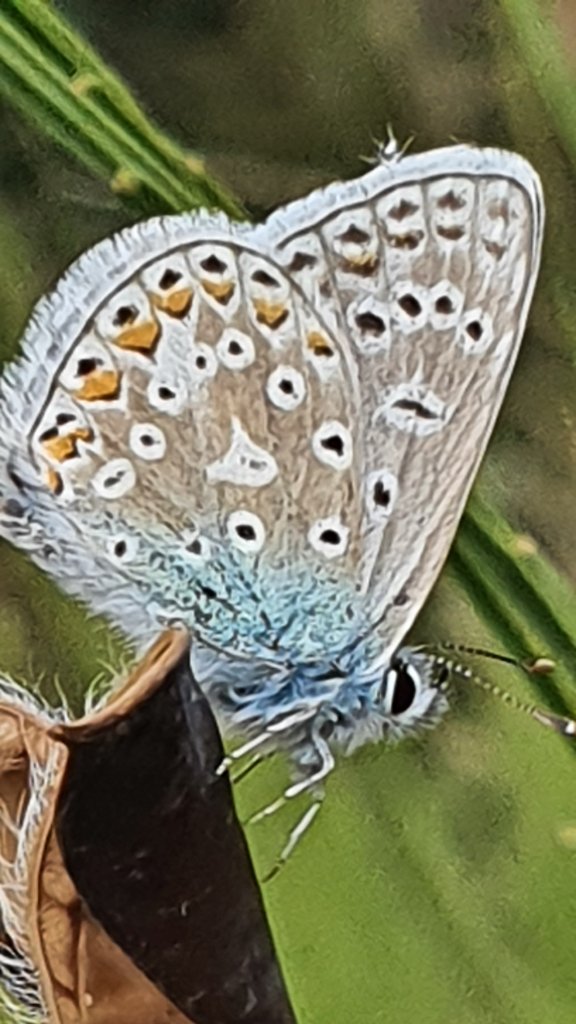
I think this is a male Chalk Hill Blue butterfly (Polyommatus coridon). It’s the first blue butterfly I think I have ever seen.

We have done this lovely route so many times, sometimes on foot, sometimes by bike. Tracks through and alongside pine woodland, then alongside meadow and marshes, through deciduous woods and finally hedgerows bordering arable land.

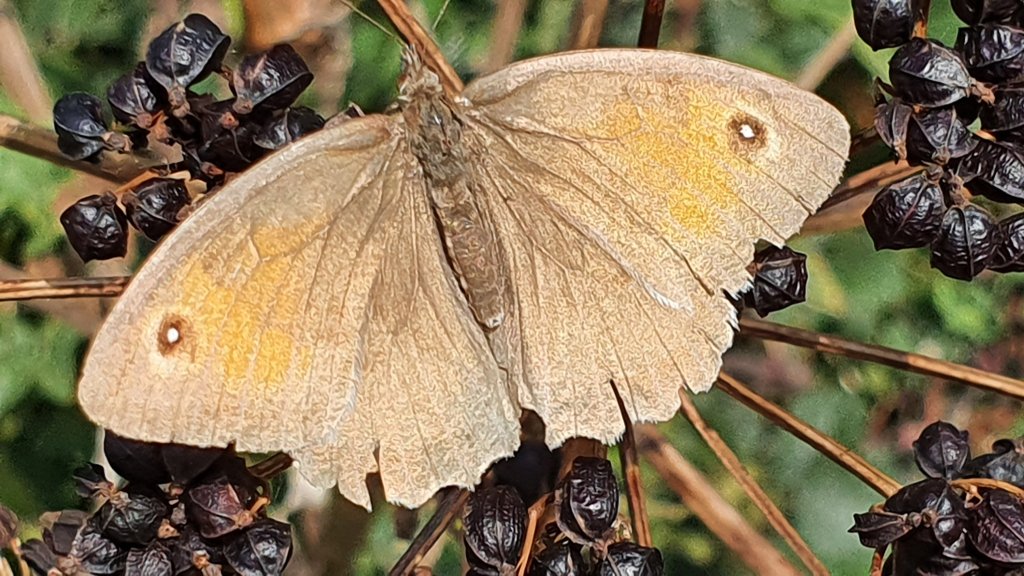
Female Meadow Brown butterfly. Our most common but still a design classic. It’s beautifully arched forewings distinguish it from any others.

On our walks, I am aware that I spend much of my time looking up or down, and increasingly less looking forward. Birds, butterflies, clouds and tree canopies compete for my attention with feathers, flowers, fungi and insects. My family are making me aware of this too, but I think it’s with some affection. They humour me by putting feathers I pick up into my backpack for me.

The way these tall trees on the Holkham estate lean in on each other provides a sense of shelter and protection. Not only for the flora and fauna. Every season we have been here, I get the same secure feeling.

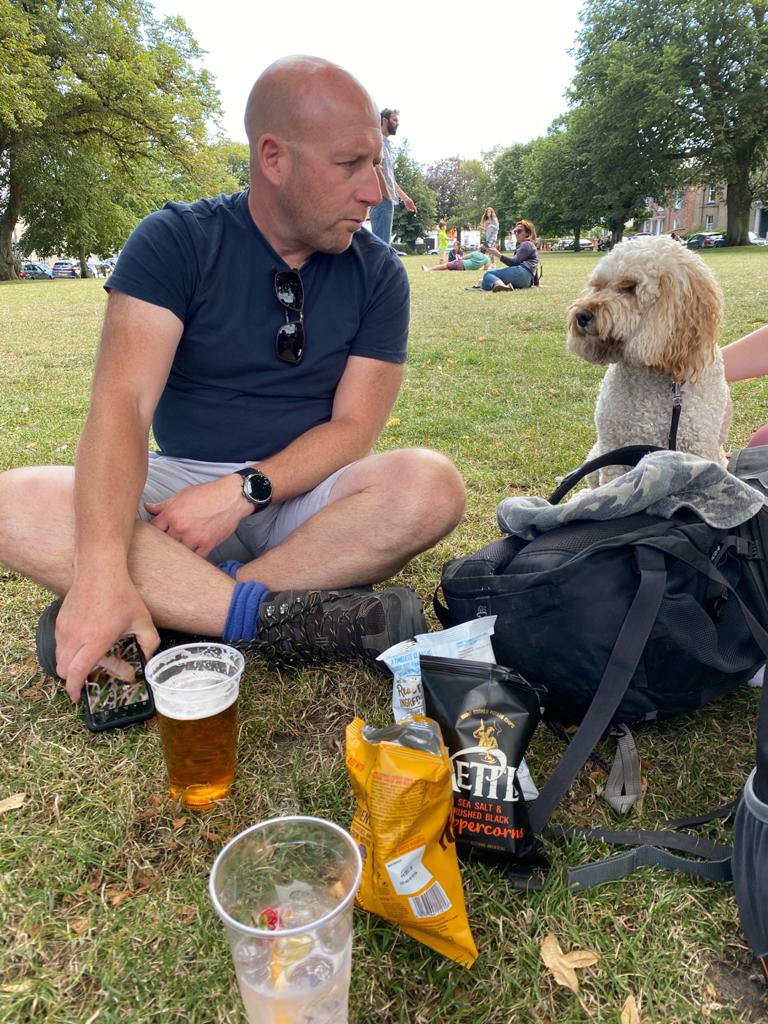
2pm I’m now lying on the grass at the Buttlands in Wells with a pint and my wonderful family. We have done another very satisfying walk.

We have spent many hours sitting and socialising on the Buttlands of Wells. It’s on the highest part of the town and is an oblong patch of grass, surrounded by trees, bordered by a road and beautiful houses on all four sides. Oh, and two pubs.

A wise man told me recently that the Buttlands was the place all gentlemen came to practice their aim and technique with the bow and arrow.

In the mid 13th century, it was set down in law, that all men between the ages of 15 and 60 should be ready and able to bear arms and fight if the country required it. The weapon must be a bow and arrows.

A hundred years later, King Edward III decreed that on Sundays and holidays all English men must practice archery at a designated space called the ‘Butts’. These spaces were set up in towns and villages up and down the kingdom. It was considered so important that noncompliance would be punishable by death. Equally, if someone was killed by a stray arrow no punishment would be lodged against the killer!

Now, we sit under the shade of a spralling beech tree, supping a pint or two and congratulating ourselves on our own, less violent, achievement. And a back catalogue of many, many happy memories.

Day 135

Sunday 02 August

9am I woke this morning to the sound of young gulls cawing just outside the caravan and the tapping of pigeons on the tin roof. It was 5.52am but I smiled regardless.

At 8am, Stan and I went for a regreshing run to shake the early morning cobwebs away. Then, with strong coffee and a bacon and egg sandwich, we made a plan for the day ahead. We know that the whole region is very busy at the moment, so parking anywhere is going to be a challenge. As I looked at the map a couple of Pied Wagtails quick-walked their way along the decking rail opposite us.


Hopefully we will be able to find a place to park at Cley-next-the-Sea and do a circular walk around the salt marshes and along the beach. An easy 4km walk to start the week. Bigger plans for tomorrow.

Starting from Cley village we walked the Norfolk coastal path to start. Past the iconic windmill which used to pump water off the marshes.

4.30pm I’m sat with the family in the courtyard of The Anchor Inn, Morston. Enjoying a really satisfying pint of Wherry after an 8km circular walk at Cley-next-the-Sea; I vastly  under-estimated the distance. I’m finding it hard right now to think of anything more perfect. But that’s what ‘living in the moment’ is all about, I guess?

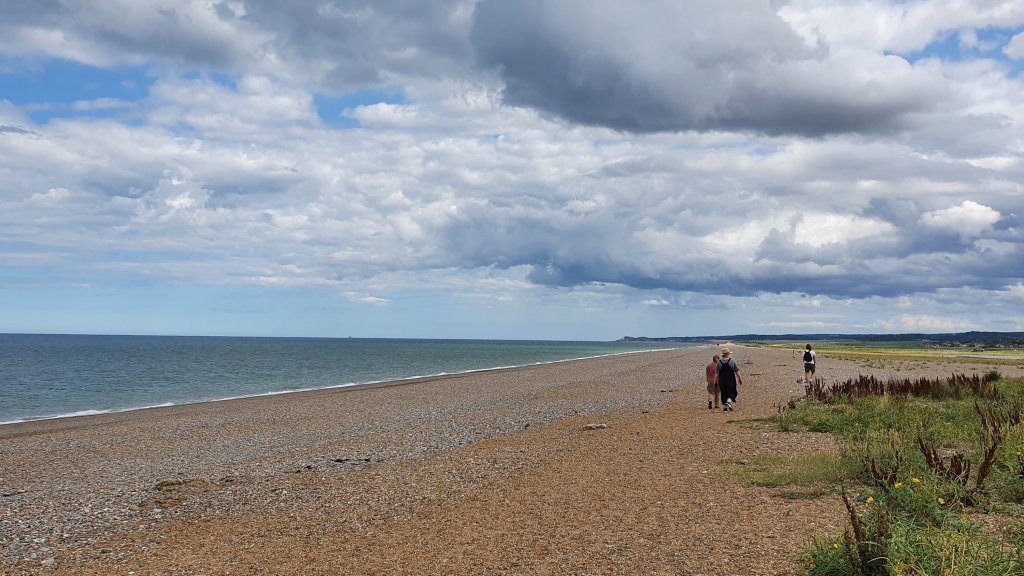
The mile or so of shingle beach which makes up a stretch of the path becomes more deserted the further you walk.

At home, in Ardleigh, the birds have gone into a kind of retreat. However, this coastline and countryside never disappoints, with some wonderful bird sightings this afternoon.

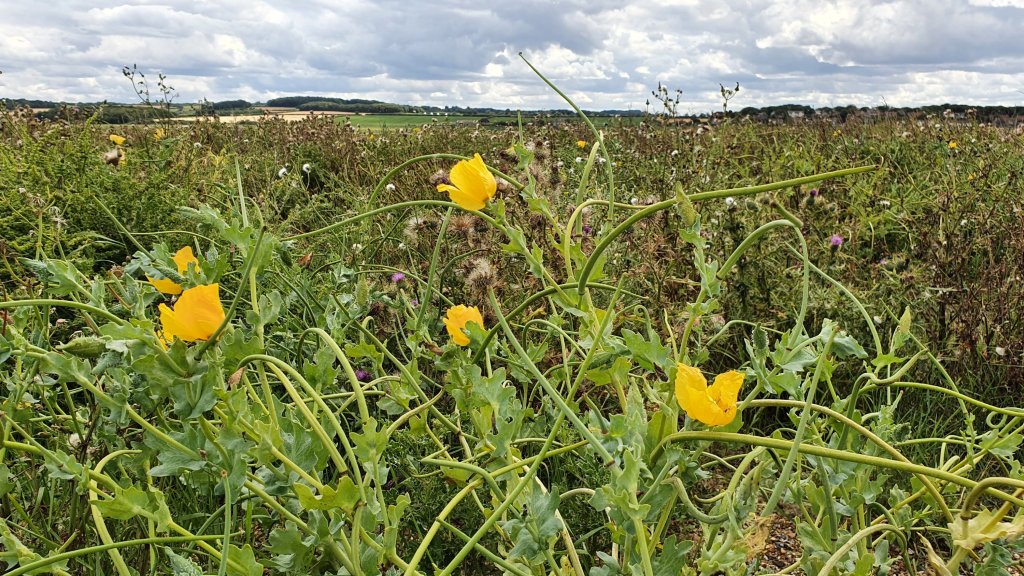
The cheery Yellow Horned Poppy (Glucium flavum) clusters along the gravel defences on the beach. A protected species in the UK mainly due to the decline of shingle beaches. But it does relatively well on the north Norfolk coast.

Why do Lapwings always seem so happy? Whether they’re trudging across mud flats searching for invertebrates or engaged in aerial shenanigans with friends and foes, they always seem to be enjoying themselves. Even their call sounds like they are hysterically laughing. They have certainly made their way into my top five birds this summer. They’re like the Gazza of birds; daft, flouncy and always seem like they’ve had just the one too many

A lone Little Egret (Egretta garzetta) dtifting through the salt marsh ponds this afternoon. Even it’s Latin name is classy.

Then there is the ever graceful Little Egret. I hadn’t really noticed this elegant white wonder until this year. It’s behaviour is somewhat ghostly, wading knee deep through the water, with it’s white pantaloons kissing the pond surface. It’s contrasting bayonet-like, black bill skewers just under the surface of the water for food.

Watching an ornithological airshow above the shoreline. Well, I am anyway.

Finally, I was treated to an aerobatic display by a quintet of skydiving  Common Terns. Standing on the shingle shoreline looking out to sea with my binoculars I watched these flying sea-daggers perform their high-speed stunts. Racing along the sea edge, at almost perfect equal spacing, heads pointed towards the water. Then, in an instant, they scream down, one after the other, stabbing small fish just below the breaks.

The birds are back!


A macabre triskelion of hooved limbs on the shingle this afternoon. Natural or supernatural?

But there were other things spotted this afternoon. Two, very disturbing, carcasses of very similar furry, fawn coloured creatures on the beach. They had hooves; on a shingle beach! Had they strayed the wrong way or perhaps been dragged there? If the latter, then dragged by what? There was also a wing from a Tern – no sign of any other body part. There must be a tale or two there? Could it be the mythical creature from the Cley salt marshes? That may be the reason for the cordoned off areas along the beach; to protect unsuspecting ramblers from a grizzly demise? The laminated notices of closed pathways due to Covid19, or no-go areas protecting ground-nesting birds; are they a convenient cover up?

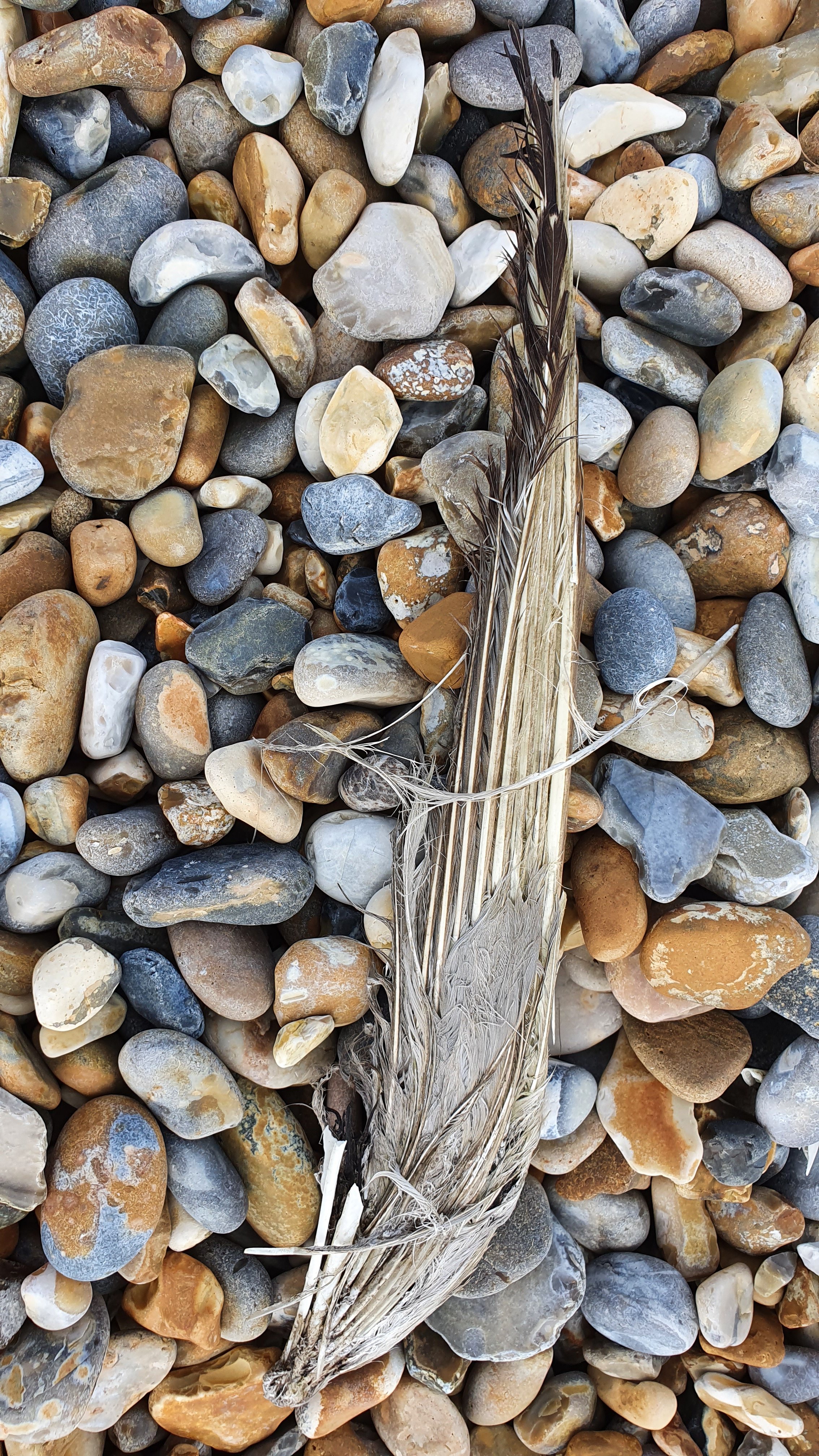
I think this is the right wing of a Common Tern (Sterna hirundo). No other body parts we’re nearby.

We are off on another walk tomorrow. In land this time to Walsingham and back to Wells. An East Anglian hot-spot of strange, where I feel that dead eyes are always watching me. Lisa and the kids really don’t like it there either, it spooks them.

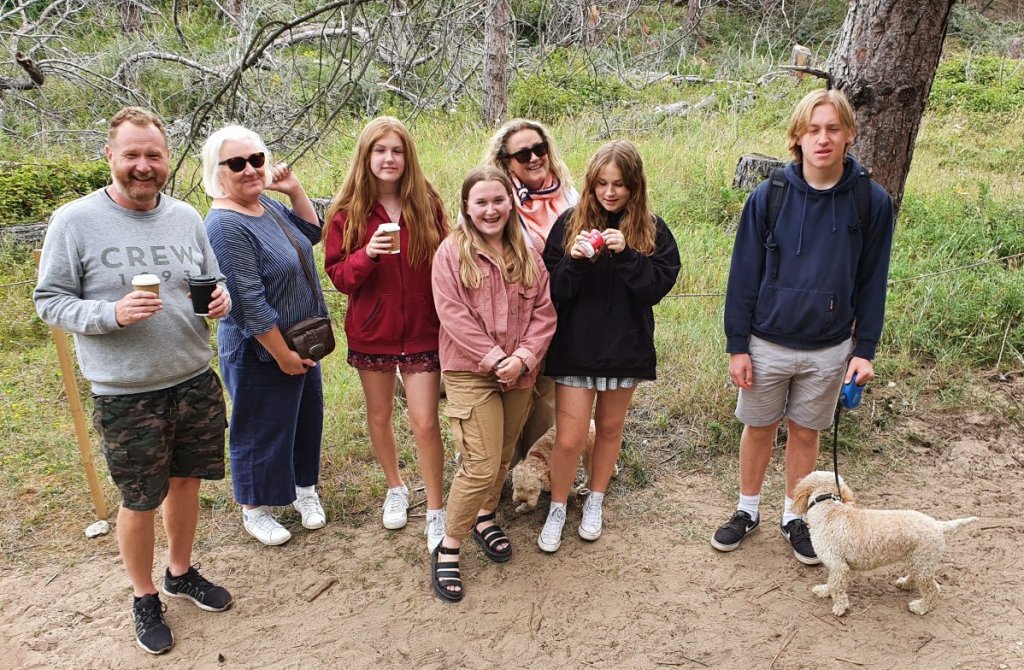
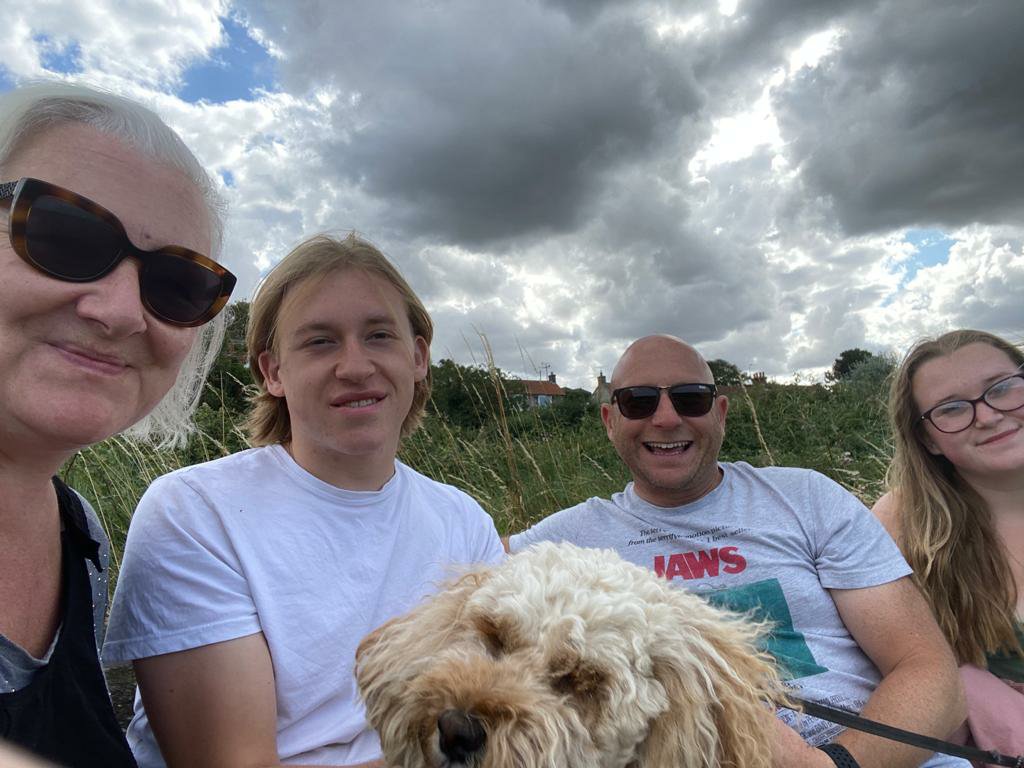
Five go on another adventure.

Day 134

Saturday 01 August

Up in Norfolk again today; in Wells-next-the-Sea with the family. We so totally love this part of the planet and have done for many years.

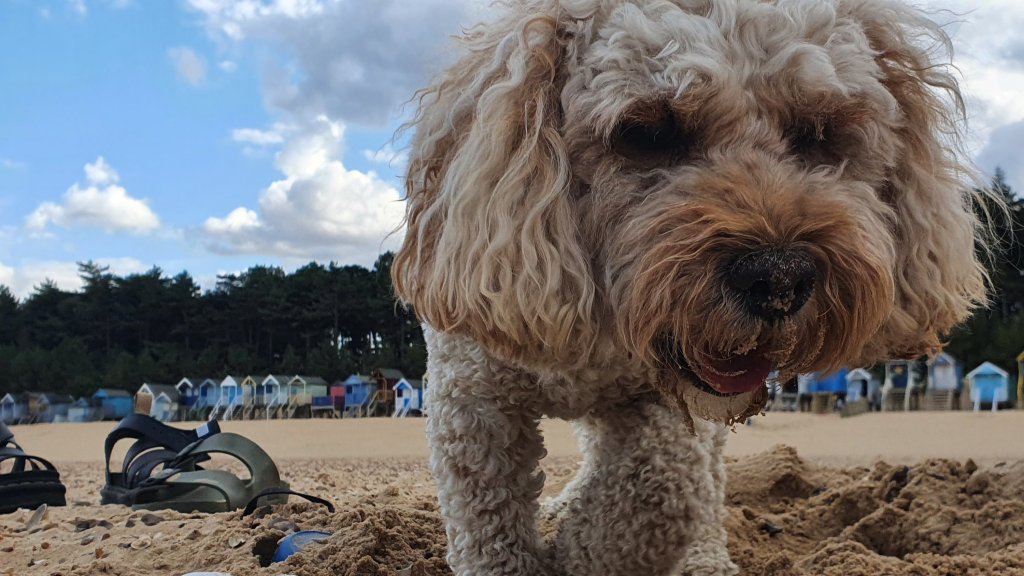
Mabel loves it up here too. She was off the lead on the beach this evening and loved it.

A poor turn out of moths last night but I didn’t give it much of a chance to be honest. There was a Garden Carpet moth (Xanthorhoe fluctuate) on the tree stump but I only checked once.

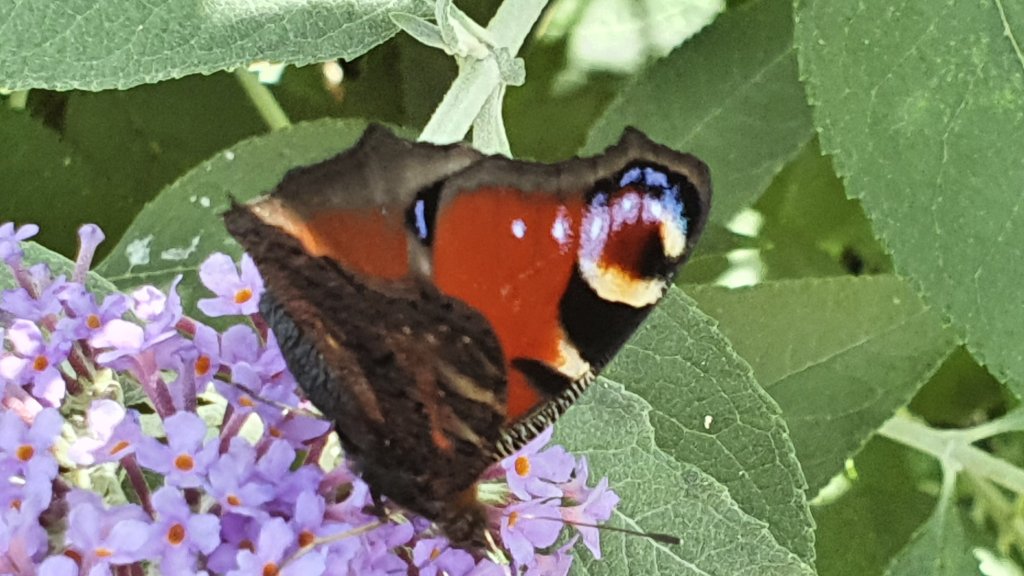
But there was a peacock butterfly (Aglais io) on the buddleia this morning. It’s the archetypal butterfly in the UK and reminds me so much of summers as a child. Probably because they are one of the later species to start flying which would have coincided with the August summer holidays. The colouring is there to confuse predators and it’s the large wing eye-spots that give it it’s name.


The journey up here was markedly busier than it has been on previous weekends recently. Boris Johnson explained yesterday how important it is for people to get out and about this summer and enjoy stay-cations. People certainly seem to be out in force at the moment. And there is a a very real worry that the virus is taking hold again.

The beaches on the north Norfolk coast are as big as the skies above them so finding space shouldn’t be an issue. We have been coming here every year since the kids were babies and although there is no Wells Carnival this year it will still be wonderful. Walks, games, beach time together. Simple stuff, again.

Day 133

Friday 31 July

About a week and half ago I turned an old shallow sink into a birdbath. Sealed the plug hole with an old jam jar lid and popped in a couple of brick bits. I filled it with tap water from the hose as I knew there were nymphs in the water-butt. Not that that was an issue, on reflection.

Mosquitoes will go from egg to larvae to pupae to adult in around 14 days.

The birds have been using it and it’s near to one of our feeding stations. I have been out there this morning and thought I would top it up only to discover it is teeming with mosquito larvae.

Just a shallow vessel of water, and ten days later life has made it’s way in and colonised it. Another creature feared by humans due to it’s potential to spread diseases such as malaria, encephalitis and various fevers. It’s true that this tiny insect is responsible for infecting hundreds of thousands of people each year, leading to fatalities. Making it the most dangerous creature on the planet to humans. But I didn’t realise that in a shameful second place are humans themselves. Well behind us come snakes, crocodiles, spiders etc.

I currently have a mosquito bite on my calf which itches and is a swollen bump. This is a simple allergic reaction to the saliva of the insect after it has bitten and taken some of my blood. It is the case for pretty much any creature it bites. This is, in most cases, particularly in the UK, the common reaction to a mosquito bite. The danger arises when it extracts blood, and pathogens contained in the blood, from a carrying animal. Then goes and bites another animal, and another and so on. So, I must remember that it’s not the mosquito that kills, it’s the pathogens that it can carry.
Mosquitoes have a history in mythology too. Tales from Greece tell stories of the tiny Mosquito felling the mighty Bull.

But the most important thing to appreciate is that they are food for many, many other creatures. Frogs and tadpoles, fish, and other insects feast on the larvae whilst in the sub-aquatic stage. Whilst birds, bats and spiders eat the flies. It really makes me appreciate the importance of the food pyramid and the ecological relationships that exist. We need loads of mosquitoes as does so many other living things.

Is the second spike starting across Europe?

I started this blog when we went into lockdown, with a very different agenda. So, today the government has announced that some parts of the UK are having their restrictions reintroduced due to spikes in the coronavirus. Also, flights from Spain and Luxembourg will need travellers to quarantine for 14 days. France, Belgium and Spain have seen significant rises in cases of Covid19. The question being asked of the PM at a hastilly arranged press conference this lunchtime was whether a second wave was heading our way? We will see.

I’ve had a go at making a moth trap liquid. Beer, bananas, syrup, sugar. I’ve painted it on to fence posts and tree trunks in the back garden. I’m going to check them out this evening and have plenty of mix left over for other evenings throughout August. I have never seen an Elephant Hawk Moth and would love to see one. Fingers crossed.

By the way. So warm today. 33° and pretty humid with little to no wind. Perfect for moths, let’s see.

Day 132

Thursday 30 July

I read a couple of shocking articles this morning that made me too upset to be sad.

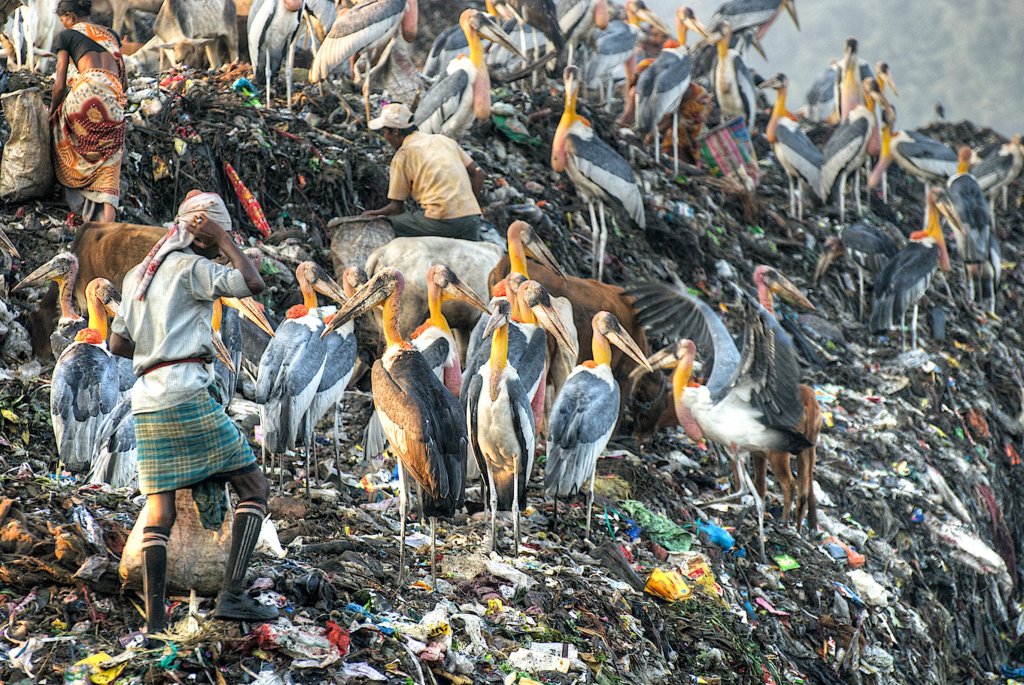
In the slums of north-east India, the Greater Adjutant stork mixes with humans to forage in the rubbish tips for food. They also roost there at night.

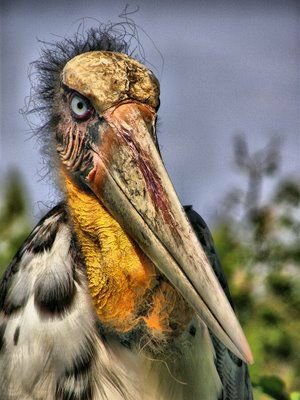
The Greater Adjutant stork (Leptoptilos dubius). Dignity and habitat wiped away by human ambition.
The storks’ wetland habitat is being destroyed by humans smearing their mucky influence wider and wider. This, sadly, gives the birds no other option than to drop any fear of the creatures that have destroyed their homes. And move in with their noisy, polluting neighbours.

Only a mother could love it?

The bad news sadly doesn’t end there. You see, these birds are now considered pests and the way they look does little to endear them to the locals peoples’ affections. There are believed to be only around 120 mating pairs remaining.

It’s hard to refute, that compared to other birds (other storks even), it’s not going to win any beauty competitions. It has a bald head, an orange undulous neck, no song to sing about, and a stiff gait that gives it it’s militaristic name. But we humans have (generally) turned our gaze shamefully away from ‘different’ or what we perceive to be ‘ugly’. I’ve done it myself. And even in this blog I celebrate the ‘beauty’ of what is around us; but it’s more about the ‘incredble-ness’, rather than beauty. Beauty is the diversity; of size, colour, behaviour, adaptability, history, variation, interconnectivity.

Reading about our stork makes me too upset to be sad. Of course, it’s easy for me to complain and judge from a distance. But, closer to home, urban foxes raiding litter bins, seagulls and pigeons feeding off food scraps we throw on town pavements. We must think twice about why those animals are living so closely to us in the UK and question what forced them to adapt their behaviour in the first place? Mirror anyone?

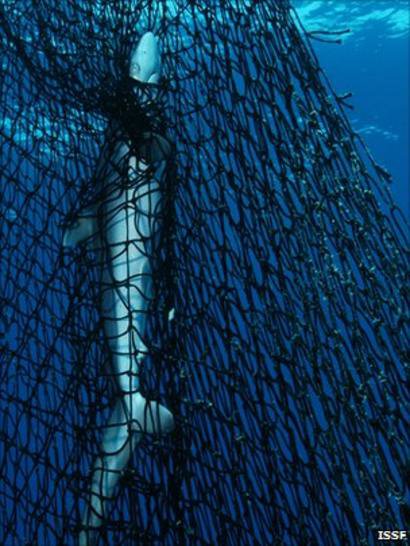
Then, the shark. Alongside the big cats and snakes, probably the most feared creature on the planet. But this fear, bordering on hysteria amongst some, is of course an irrational one.

In 2018, shark attacks accounted for four deaths worldwide. To put this into context, on average, ants kill 30 people a year, and bees around 470. Shark numbers are falling.

We kill millions of sharks each year. Some are hunted for their fins, skin, liver etc. Others are caught up in industrial sized fishing nets; tuna trawling nets bag five sharks for every ten tuna fish. Incentive alone for checking the tin for ‘line-caught’ the next time I am at the supermarket.

BBC News – Ship sails in search of sustainable tuna
http://www.bbc.co.uk/news/science-environment-13346107

And, of course, that’s what it all boils down to. Our pursuit of a convenient and expansive existence at the expense of everything else. We seem oblivious at times, to the impact we are having on the world around us. And we won’t notice it until it’s gone, and far too late to correct it. We have history there too.

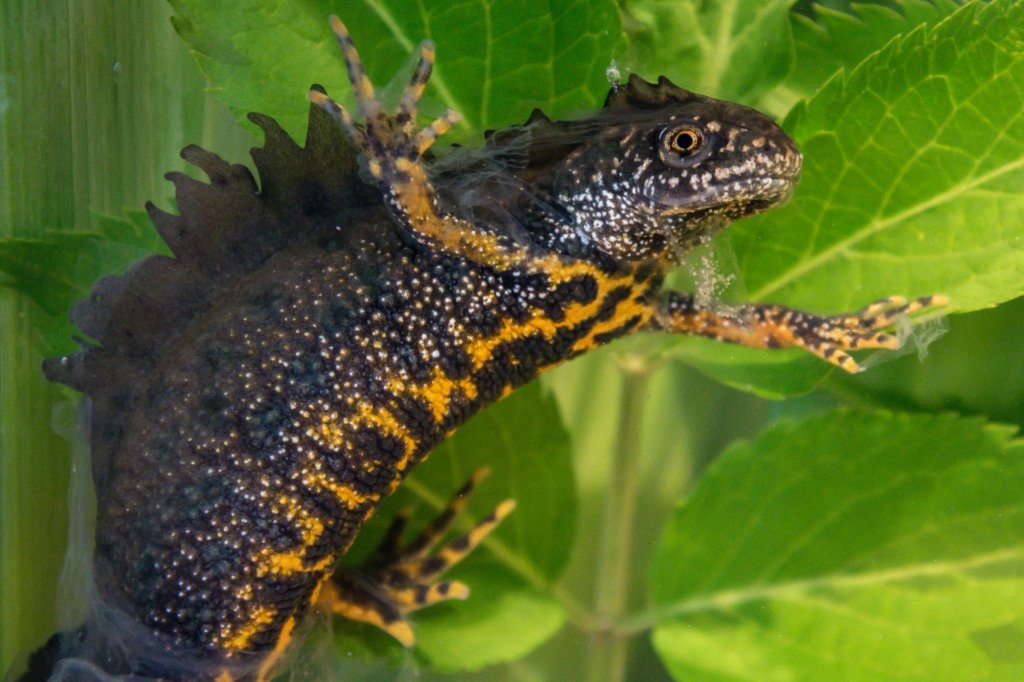
Great Crested Newts or classrooms. I would let the pupils decide.

I was part of a conversation recently at my previous work place. A building extension was being planned to a school but was delayed and possibly going to be cancelled altogether because of the discovery of Great Crested Newts on the site. To most around the table they were referred to as ‘bloody newts’. I felt I had to step in to defend the newts and the laws that would eventually lead to the project being cancelled. We are lucky in this country to have really tight regulations that protect our natural spaces and respect their inhabitants, flora and fauna. I simply asked my colleagues “What would the kids say, if you told them that we buldozed away this endangered creature and it’s valuable habitat so that they could have a new classroom?” Silence.

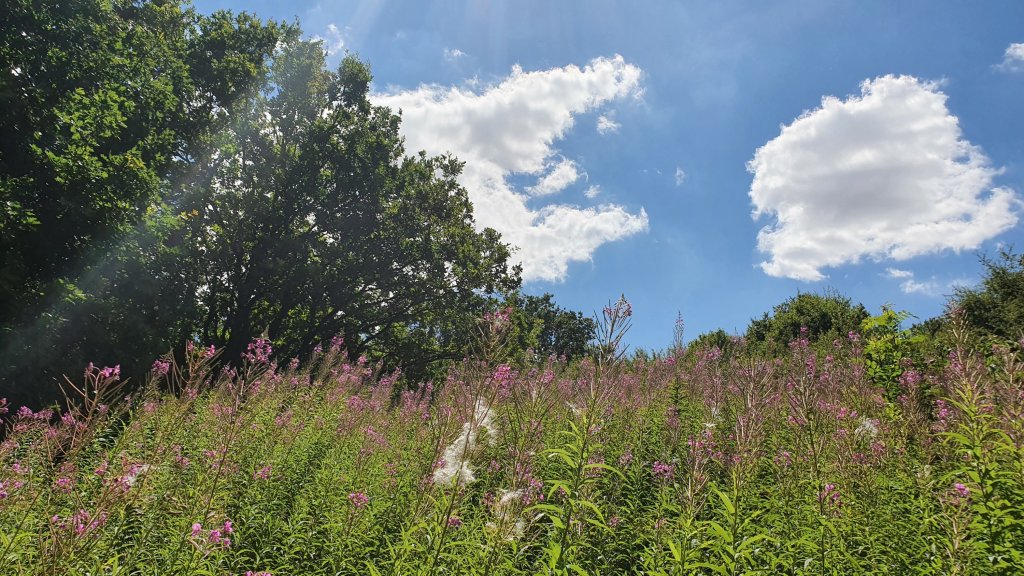
I know I’ve gone a bit ‘Dave Angel’ in this post. Back to normal tomorrow. But in the meantime, and to wallow a little in the sheer perfection of nature under my nose, whatever it looks like…

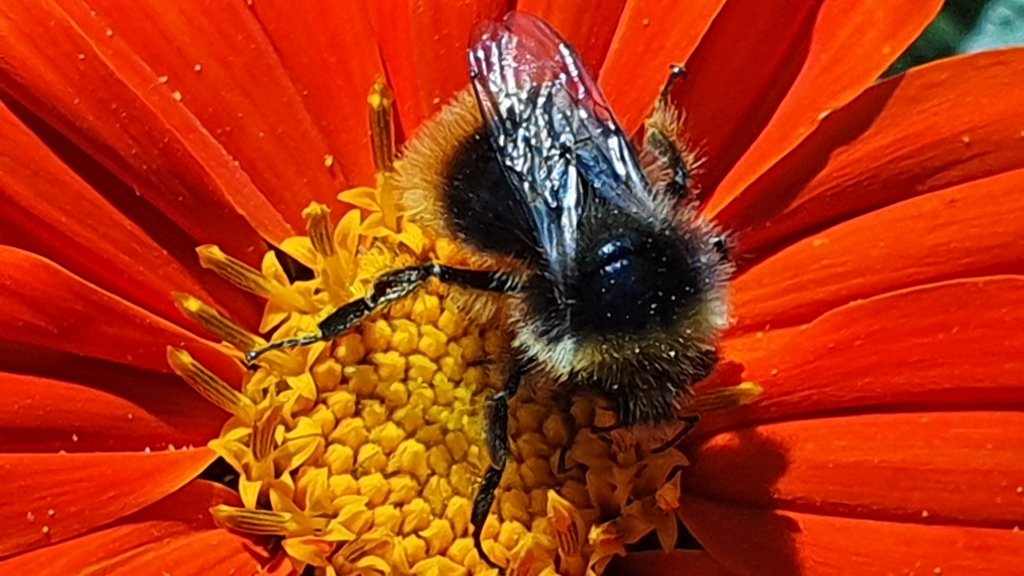
A red-tailed bumble bee on a hot Tithonia Torchlight flower in our back garden this afternoon. It’s one of those pictures to zoom in on.
Day 131

Wednesday 29 July

One of those glorious summer days when the clouds never seem to eclipse the sun.

A beautiful summer day. A gentle breeze and non-stop sunshine with plenty of big, white, happy cumulus clouds. Although they are generously scattered across the sky they never seem to block the sun. One of those days. A good day.

We decided to go for a midday, midweek walk at one of our favourite places. Wrabness and Copperas woods, about fifteen minutes drive from home. It’s a lovely couple of hours walk that seems longer because of the variety of scenery we encounter. The time goes too quickly, as does the walk. It’s one of those walks that I take more slowly towards the end just to make it last a bit longer. A bit like the first pint.

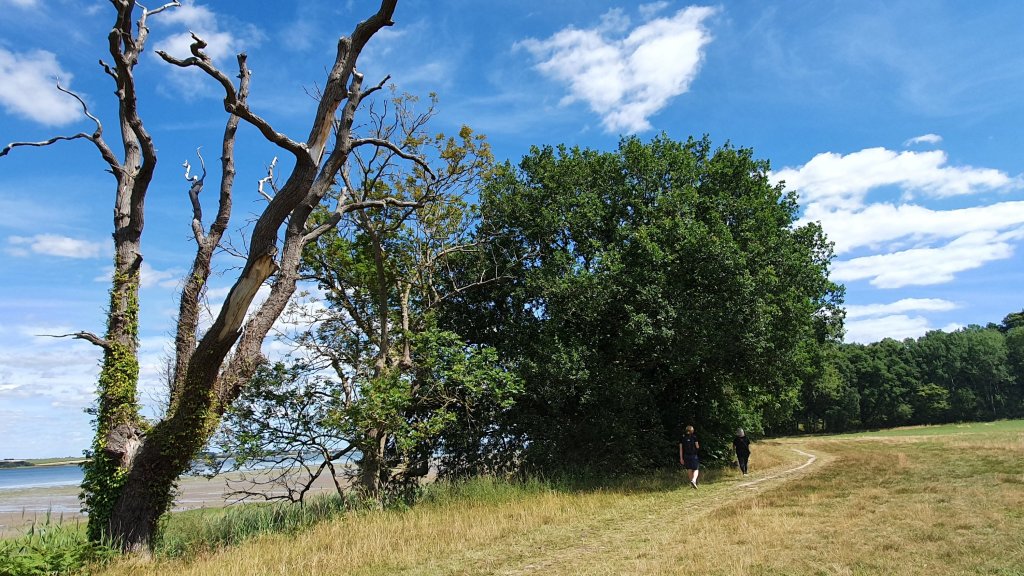
I am noting a number of personal favourite places on Earth. I think this meadow, on this walk, alongside this stretch of the Stour estuary is one of them.

The walk takes us through acres of ancient deciduous woodland and along agricultural fringes with views of Grayson Perry’s golden ‘A House for Essex’. Half way around, the walk opens up on to a vast meadow that, ever-so gently, banks up from the Stour estuary back to the woods. Today, a Green Woodpecker swung across the full meadow breadth like tarzan swinging from vine to vine.

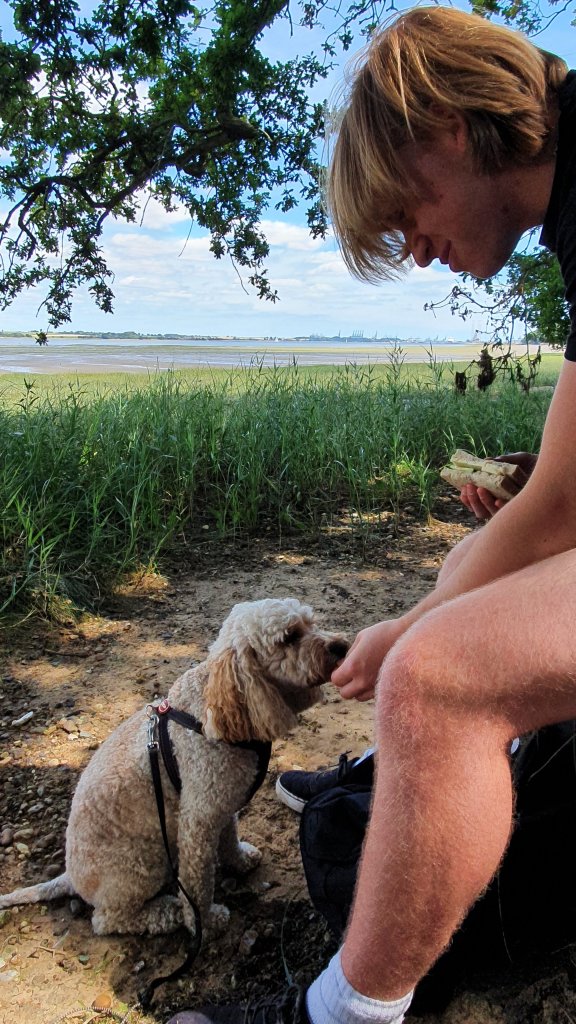
Another simple pleasure. A stop to enjoy a sandwich and listen to the water birds and the breeze in the trees.

Some places simply have a lovely feel…what would you call it? Vibe? Ambiance? Aura? I don’t know what the best word is, it just feels good to be there. Whereas, other places can feel quite the opposite of course, and I could list a few of those too. I still visit them but I have a slight trepidation beforehand and feel a bit wary whilst there. It feels like something bad or sad has happened or might happen. I think I will need to visit this topic again soon.

But this walk, through these woods and along this track? Only good feelings here.

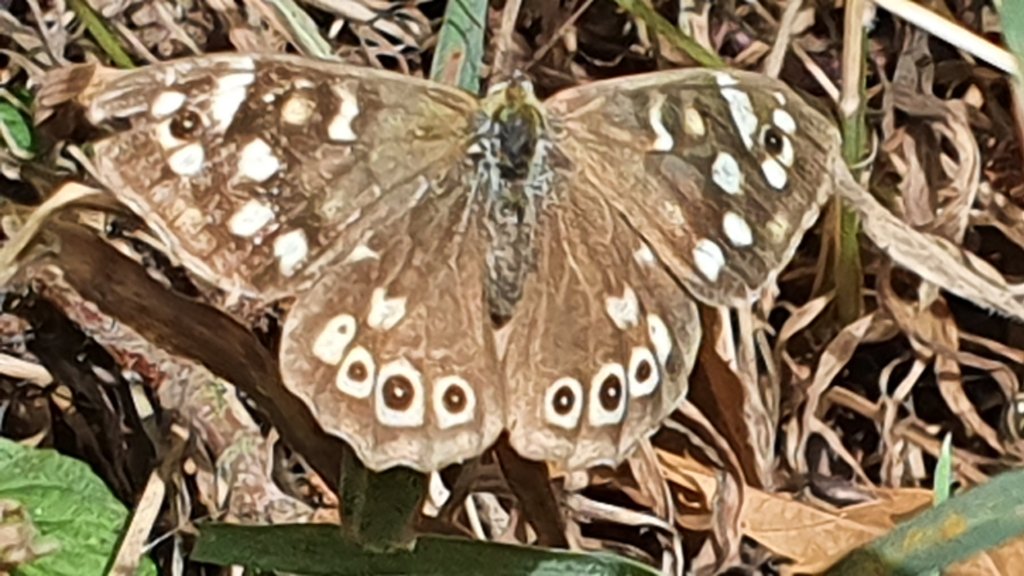
The Speckled Wood (Pararge aegeria) has bucked the trend of doom and gloom surrounding UK butterfly numbers over recent years. Still far from common their numbers have nevertheless increased. Really pleased to have seen this female today (she is not so brightly coloured as the male).

At this time of year the birds seem to hide away enjoying a day-long siesta. But the butterflies are full-on at it, making the most of the warm and dry July weather.

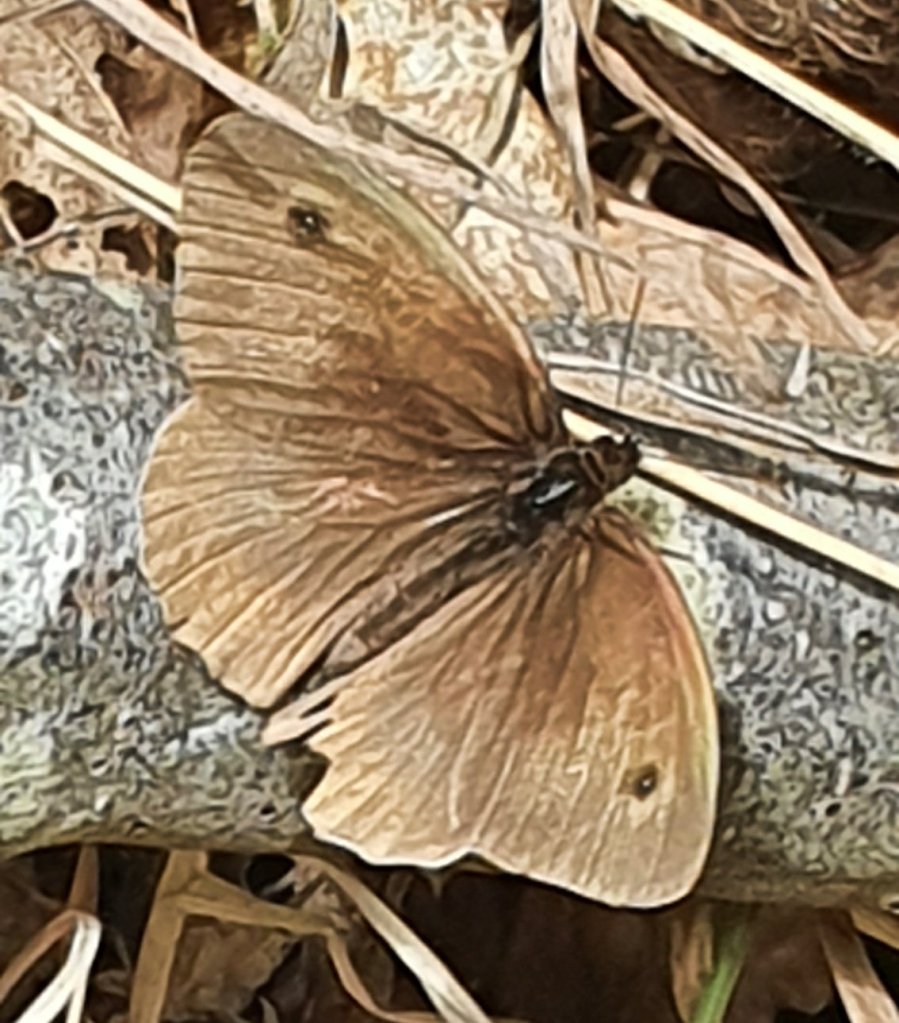
Male Meadow Brown (Maniola jurtina). These are the most common butterfly, in number, in the UK and throughout Europe but can vary greatly in colour, pattern and size. In particular their forewings are slightly larger further north to aid thermoregulation.